PhoneStop vs StayFree
The tracker. The clearest picture of where your hours went, on Android, for free.
By Ruslan Shchuchkin, who built PhoneStop · · Read this page as Markdown
The short version
Use StayFree for a week first: genuinely, it is the fastest way to find out that you are on the phone for five hours a day and not three. Then decide whether you need something that acts on that number. If you do, that is what PhoneStop is.
| PhoneStop | StayFree | |
|---|---|---|
| Platforms | Android | Android, iPhone, Chrome |
| Price | Free | Free with a premium tier |
| What it does when you hit the limit | Full-screen stop, then a reset and a one-tap lock | An overlay warning, and a block screen on the app you set a limit for |
| Warns you before the limit | Yes: at roughly 60, 30 and 10 minutes left | Yes: usage-limit alerts on individual apps |
| How it enforces | Foreground service and a display-over-apps overlay | Usage access, plus an accessibility service for websites |
| Blocks individual apps | No: it budgets your whole screen time | Yes: per-app limits and blocklists |
| Account needed | No | Optional |
| Screen time leaves the phone | No. Only anonymous taps, which you can turn off. | Optional account and sync |
How each app stops you
StayFree and PhoneStop both start from Android's usage data and go opposite ways with it. StayFree turns it into reporting: per app, per day, per week, with limits you can attach to individual apps.
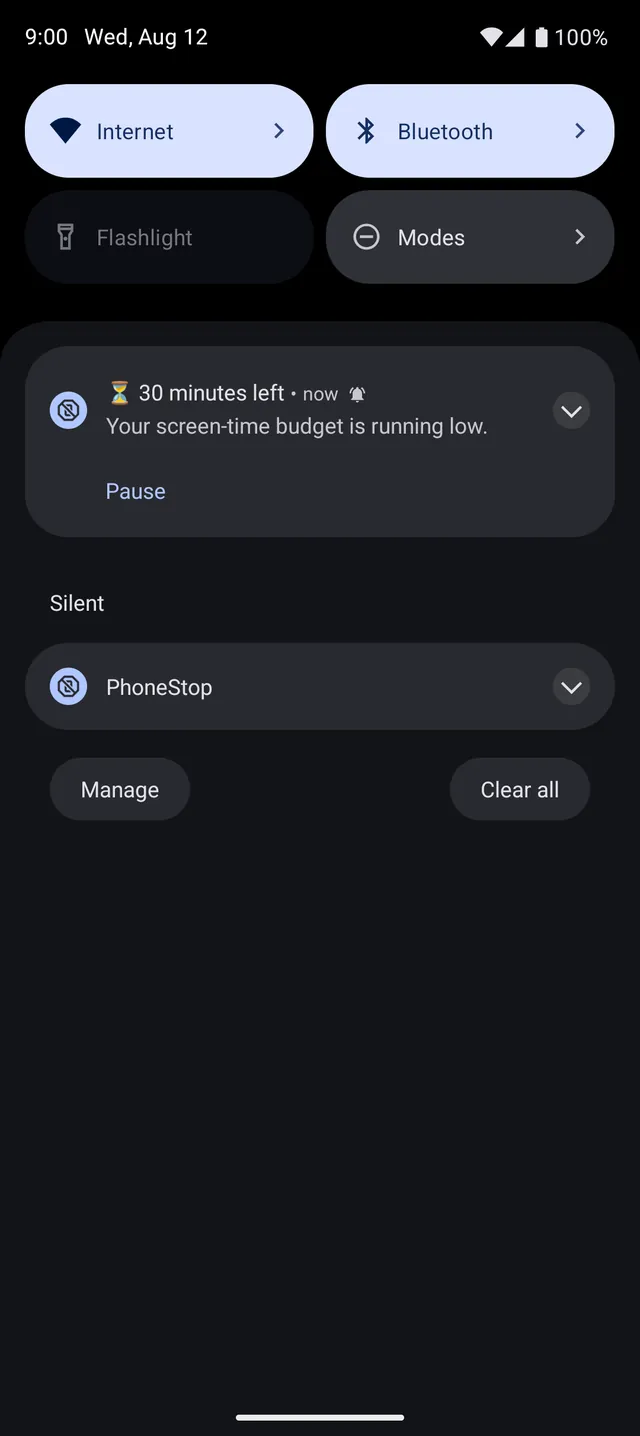
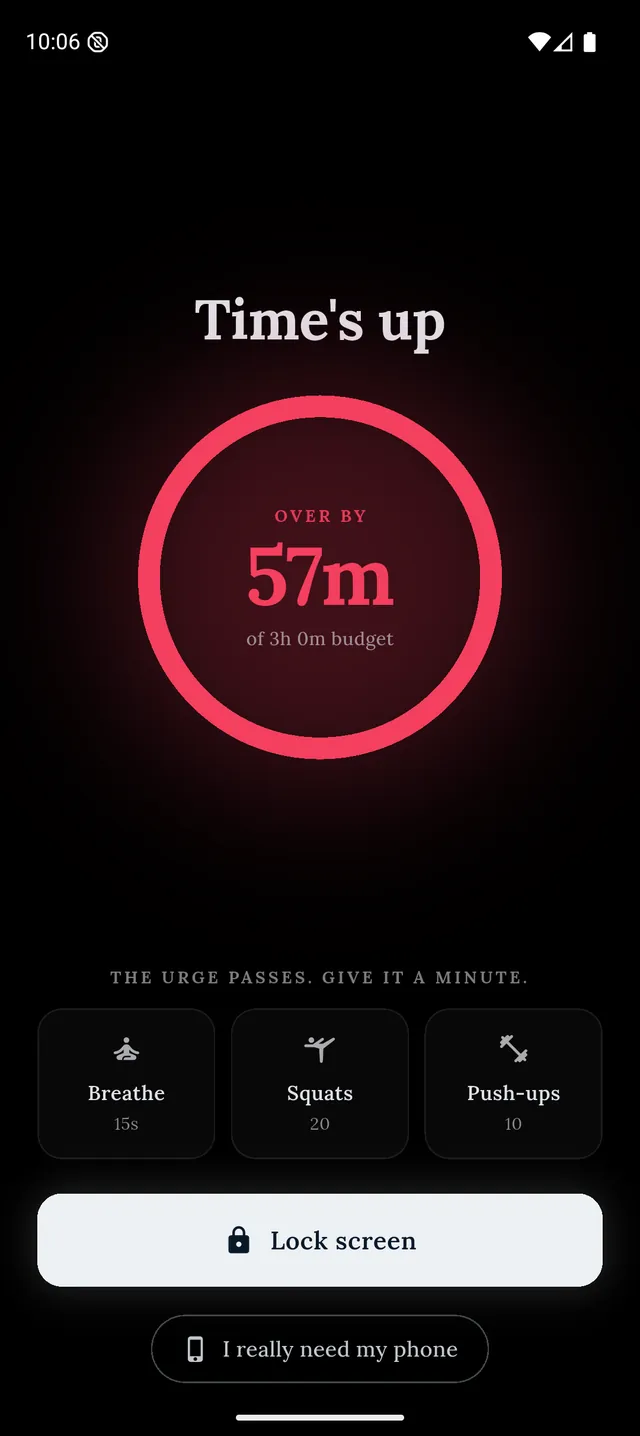
PhoneStop turns it into one countdown. There is a single number for the day, it is on the home screen as a ring that drains, and the app's whole job is to make sure you know where that number is before it is gone: warnings at 60, 30 and 10 minutes, and a full screen at zero.
Where StayFree is the better choice
- Far better statistics. Per-app history, comparisons, streaks of data PhoneStop simply does not collect.
- Per-app limits, if a single app is your problem.
- Website blocking through the accessibility service.
- It is also on iPhone.
Where PhoneStop is the better choice
- One number instead of forty. A budget you can feel, rather than a report you read.
- The interruption is the product. Warnings that reach you inside other apps, then a stop you cannot scroll past.
- Free, with no ads. An optional $9.99 Supporter upgrade adds an extra notification tone; every core feature stays free.
- Your screen time never leaves the phone.
What PhoneStop does at the limit
The whole product is three moments. Warnings arrive as the budget empties, inside whatever app you are in:
PhoneStop
30 minutes left
Half an hour of budget to go. A good moment to pick where it goes.
PAUSE
PhoneStop
Time's up
You are out of budget for today. Take a minute, then lock the phone.
PAUSE
Then, at zero, the screen is taken over: a fifteen-second breath or twenty squats, and a button that locks the phone. If you genuinely need it, one tap extends the window and says so honestly, because an intervention you cannot escape is one you uninstall.
Disclosure: we make PhoneStop, so treat our own entry with the scepticism it deserves. Everything else here is written from public information and hands-on use; prices and platforms were checked in September 2026 and change often, so check the vendor before you pay.
PhoneStop is a free Android app. Set a daily screen time budget, get warned before it runs out, and get stopped when it does.

Android. No account, no ads. Your screen time never leaves your phone. An iPhone version is coming soon.
Questions people ask
Is StayFree accurate?
It reads Android's own usage statistics, so it is as accurate as the system data, which is very, with the usual caveats about screen-on time versus active use.
Does StayFree block apps or just track them?
Both, but the blocking is the weaker half: per-app limits with an overlay you can dismiss. The tracking is what it is best at.
StayFree or PhoneStop?
StayFree to find out where the time goes. PhoneStop to have something happen when it goes.