PhoneStop vs Digital Wellbeing
Already on your phone, free, and the reason most people think screen time apps do not work.
By Ruslan Shchuchkin, who built PhoneStop · · Read this page as Markdown
The short version
Turn on Digital Wellbeing tonight: it costs nothing and it will tell you the truth about your week. If you find yourself dismissing the timer most days, that is not a discipline failure. It is the product working exactly as designed, and it is the reason PhoneStop exists.
| PhoneStop | Digital Wellbeing | |
|---|---|---|
| Platforms | Android | Android (built in) |
| Price | Free | Free |
| What it does when you hit the limit | Full-screen stop, then a reset and a one-tap lock | The icon greys out and a Time's up screen appears, with a button to dismiss it for the day |
| Warns you before the limit | Yes: at roughly 60, 30 and 10 minutes left | No |
| How it enforces | Foreground service and a display-over-apps overlay | Part of the operating system |
| Blocks individual apps | No: it budgets your whole screen time | App timers per app, plus Focus mode and Bedtime mode |
| Account needed | No | Already signed in |
| Screen time leaves the phone | No. Only anonymous taps, which you can turn off. | Google account |
How each app stops you
This is the fairest comparison to make, because Digital Wellbeing is free, already installed, and made by the company that makes the operating system. It is also the clearest statement of what PhoneStop is for.
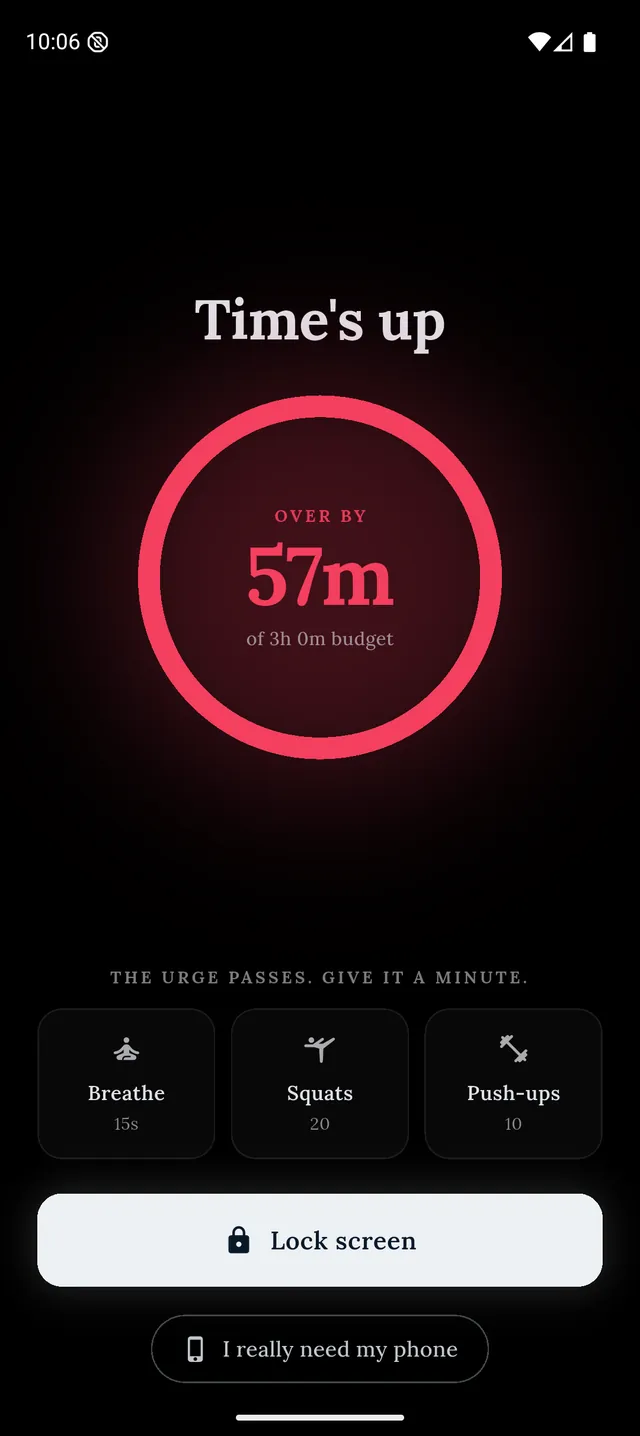
Digital Wellbeing reports and then, at the last moment, negotiates. PhoneStop warns three times on the way down so the ending is never a surprise, then takes the whole screen at zero, not with a dismiss button, but with a reset and a lock. Both let you carry on if you truly need to. Only one of them makes carrying on the harder choice.
Where Digital Wellbeing is the better choice
- It is already there. Nothing to install, nothing to trust, no permissions to grant.
- It is part of the OS, so nothing can kill it in the background.
- Focus mode is good for a scheduled block of work.
- Parental controls through Family Link, which PhoneStop does not attempt at all.
Where PhoneStop is the better choice
- A whole-phone budget instead of per-app timers.
- Warnings before the end, at 60, 30 and 10 minutes left.
- A stop that is a stop, with a physical reset and a one-tap lock rather than a dismiss button.
- It reaches the moment, not just the report. Knowing your screen time is not the same as lowering it: a weekly summary arrives after the day is spent, and a per-app timer only fires once you have hit one app.
- Your screen time never leaves the phone, and there is no account involved.
What PhoneStop does at the limit
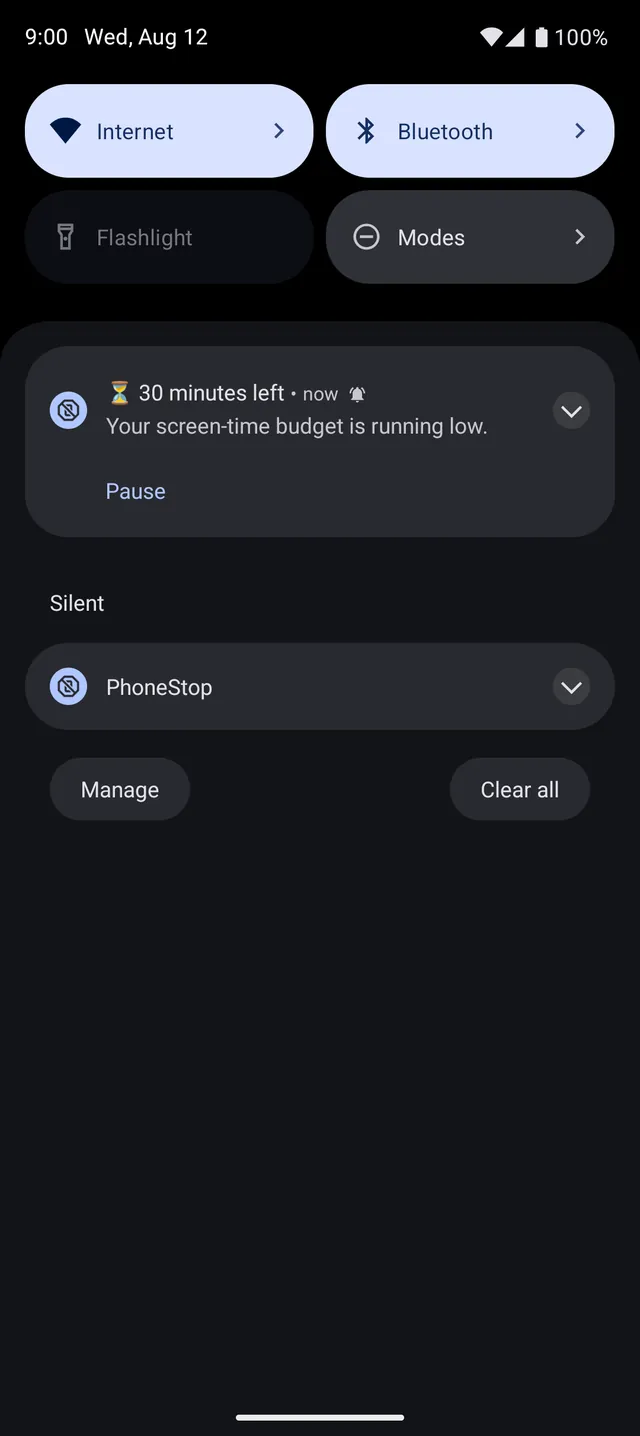
The whole product is three moments. Warnings arrive as the budget empties, inside whatever app you are in:
PhoneStop
30 minutes left
Half an hour of budget to go. A good moment to pick where it goes.
PAUSE
PhoneStop
Time's up
You are out of budget for today. Take a minute, then lock the phone.
PAUSE
Then, at zero, the screen is taken over: a fifteen-second breath or twenty squats, and a button that locks the phone. If you genuinely need it, one tap extends the window and says so honestly, because an intervention you cannot escape is one you uninstall.
Disclosure: we make PhoneStop, so treat our own entry with the scepticism it deserves. Everything else here is written from public information and hands-on use; prices and platforms were checked in September 2026 and change often, so check the vendor before you pay.
PhoneStop is a free Android app. Set a daily screen time budget, get warned before it runs out, and get stopped when it does.

Android. No account, no ads. Your screen time never leaves your phone. An iPhone version is coming soon.
Questions people ask
Can you make Digital Wellbeing app timers harder to dismiss?
Not on your own account. A timer set through Family Link with a parent's passcode cannot be lifted from the phone, which is why so many adults end up asking someone else to hold their passcode.
Does Digital Wellbeing limit total screen time?
No. It sets timers on individual apps and can dim the screen at bedtime. There is no single daily budget for the whole phone.
Is a third-party screen time app safer than the built-in one?
Not automatically: most want an accessibility service, a VPN profile or an account. Check what each one asks for. PhoneStop uses a foreground service and the display-over-apps permission. Your screen time never leaves your phone: the app sends only anonymous taps, and you can turn them off.