PhoneStop vs Brick
A $59 magnet you tap to lock and tap to unlock. The most effective answer, if you leave it in another room.
By Ruslan Shchuchkin, who built PhoneStop · · Read this page as Markdown
The short version
Buy Brick if you have already tried three apps, defeated all three, and know that the missing ingredient is physical distance. Install PhoneStop first if you have not measured your week yet: it is free, and the number may be the only intervention you need.
| PhoneStop | Brick | |
|---|---|---|
| Platforms | Android | iPhone and Android (needs recent OS versions) |
| Price | Free | $59 one-time for the puck; the app is free |
| What it does when you hit the limit | Full-screen stop, then a reset and a one-tap lock | Your chosen apps are gone until you physically tap the phone on the puck |
| Warns you before the limit | Yes: at roughly 60, 30 and 10 minutes left | No |
| How it enforces | Foreground service and a display-over-apps overlay | A passive NFC tag plus the OS blocking APIs |
| Blocks individual apps | No: it budgets your whole screen time | Yes: the apps disappear entirely while you are bricked |
| Account needed | No | Yes |
| Screen time leaves the phone | No. Only anonymous taps, which you can turn off. | Account |
How each app stops you
Brick's insight is a good one: make the undo physical. Software you can argue with; a puck in a kitchen drawer requires you to stand up.
PhoneStop makes a different bet: that most overuse is not a decision you would defend, just a session nobody ended. So it does not remove anything. It counts, warns, and then at zero puts a full screen in front of you with a lock button on it. If your honest self-assessment is that you will defeat any software, Brick is the better buy. If your honest self-assessment is that you just lose track, a budget is closer to the problem.
Where Brick is the better choice
- The strongest friction here, by a distance, when the puck is out of reach.
- One-time cost. No subscription.
- It works on both platforms.
- The apps genuinely disappear, notifications included.
Where PhoneStop is the better choice
- Free, and nothing to carry.
- It handles the whole day, not one bricked block.
- It measures. Brick has no opinion about how much is too much; PhoneStop's entire model is a number.
- You can always get out honestly: extend the window in one tap and the app says so plainly, instead of making you walk to a drawer.
What PhoneStop does at the limit
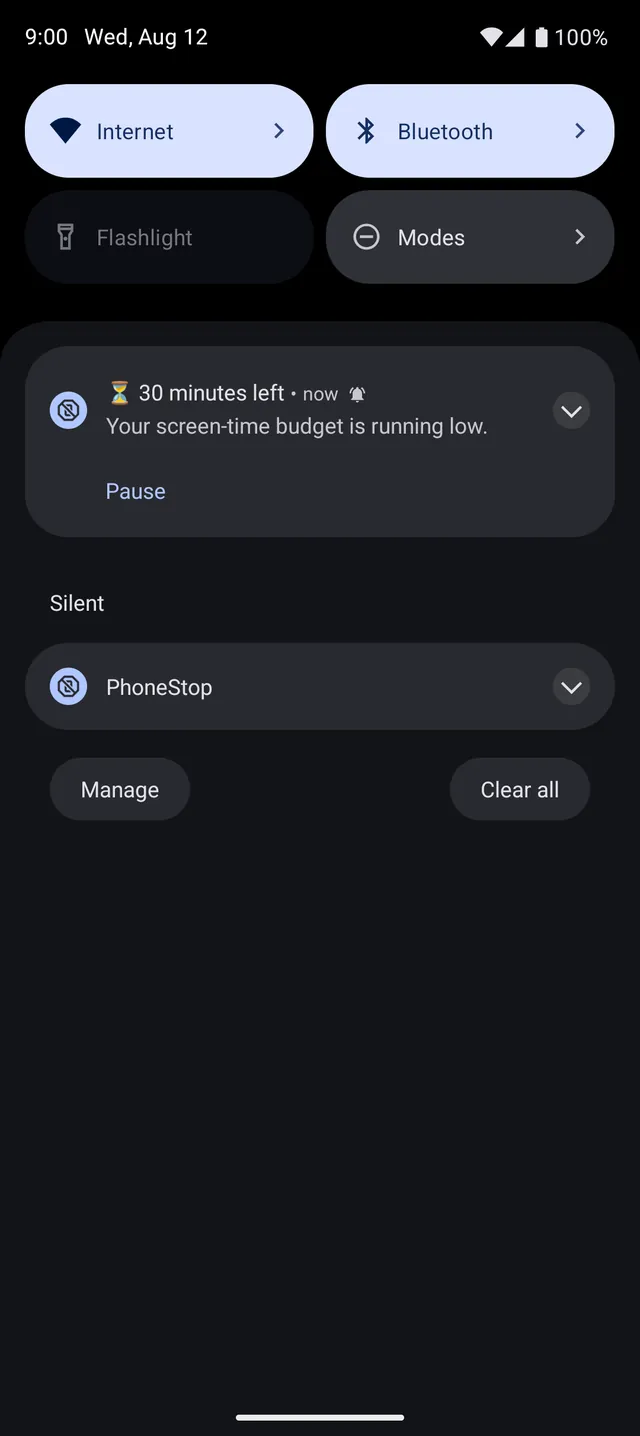
The whole product is three moments. Warnings arrive as the budget empties, inside whatever app you are in:
PhoneStop
30 minutes left
Half an hour of budget to go. A good moment to pick where it goes.
PAUSE
PhoneStop
Time's up
You are out of budget for today. Take a minute, then lock the phone.
PAUSE
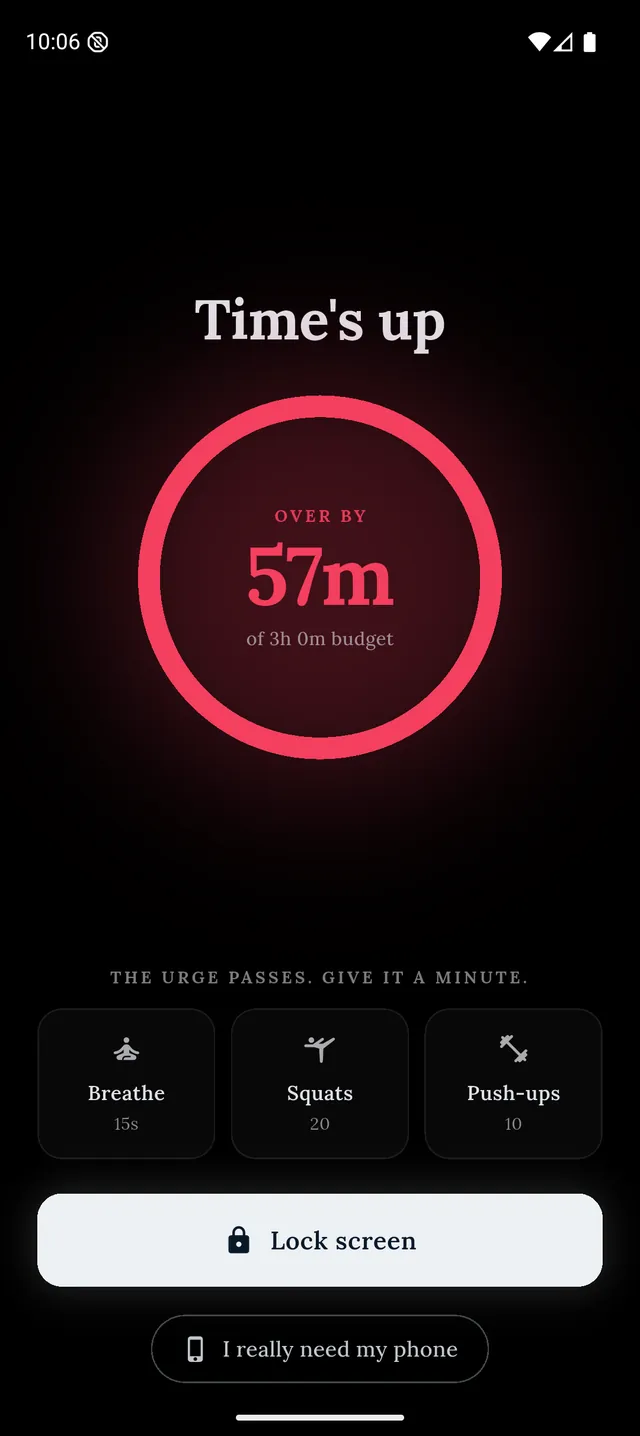
Then, at zero, the screen is taken over: a fifteen-second breath or twenty squats, and a button that locks the phone. If you genuinely need it, one tap extends the window and says so honestly, because an intervention you cannot escape is one you uninstall.
Disclosure: we make PhoneStop, so treat our own entry with the scepticism it deserves. Everything else here is written from public information and hands-on use; prices and platforms were checked in September 2026 and change often, so check the vendor before you pay.
PhoneStop is a free Android app. Set a daily screen time budget, get warned before it runs out, and get stopped when it does.

Android. No account, no ads. Your screen time never leaves your phone. An iPhone version is coming soon.
Questions people ask
Does Brick work on Android?
Yes. Brick's app supports both iPhone and Android on recent OS versions, and the puck itself is a passive NFC tag with no battery.
Is there a free alternative to Brick?
Any NFC tag can trigger an automation, and several free apps approximate the effect in software. See Brick alternatives.
Can I use Brick and a screen time budget together?
Yes, and it is a sensible pairing: Brick for the evenings you want gone entirely, a budget for the ordinary days in between.