Opal vs Forest
One of these blocks your apps and charges you for it. The other blocks nothing and asks you to care about a cartoon tree. They are not really the same product.
By Ruslan Shchuchkin, who built PhoneStop · · Read this page as Markdown
The short version
Choose Opal if you want a real block. It uses Apple's Screen Time API to make distracting apps genuinely hard to open, and Deep Focus makes the block hard to lift. You pay for that, close to $100 a year.
Choose Forest if the problem is motivation, not access. Forest never stops you opening anything. It gives you a tree that dies if you leave a focus session, and for a certain kind of person that small guilt is enough. It is cheap or free, and it is charming.
The split is honest: Opal is enforcement you resent paying for, Forest is a nudge you will happily ignore on a bad day.
| Opal | Forest | |
|---|---|---|
| Platforms | iPhone and iPad (an Android build exists but trails the iOS app) | iPhone, iPad, Android, browser extension |
| Price | Free tier, subscription for the real features (around $100/year) | One-time purchase on iOS; free with in-app purchases on Android |
| What it does when you hit the limit | Blocks the apps in your session; Deep Focus makes the block hard to lift | Nothing — the tree dies if you leave your focus session |
| Warns you before the limit | Session reminders, not a whole-day countdown | No |
| How it enforces | Apple's Screen Time API | A timed session you start yourself, with a game on top |
| Blocks individual apps | Yes — per app, per website, per category | It allows a list during a session rather than blocking one |
| Account needed | Yes | Optional |
| Data leaves the device | Yes — account and cloud sync | Optional account |
| Google Play rating | 4.5 stars (8.77K) | 4.3 stars (813K) |
How each one stops you
Opal sits on Apple's Screen Time API. You build a session, pick the apps and categories to block, and Opal holds the block; Deep Focus raises the cost of quitting early. It is a gate.
Forest holds no gate at all. You plant a tree, a timer runs, and if you leave the app the tree dies. The enforcement is entirely emotional, which is the point and the limit: nothing stops you closing Forest and opening Instagram anyway.
Where Opal wins
- It actually blocks, where Forest only guilts.
- Deep Focus makes an impulsive unlock genuinely hard.
- Per app, per website, per category control.
- Schedules and routines for recurring focus times.
Where Forest wins
- It is cheap or free, against Opal's ~$100 a year.
- It is on Android as a first-class app, where Opal's Android build trails.
- The tree works for people who respond to a small stake.
- No block to resent, so nothing to rage-uninstall on a hard day.
Both measure a session, neither measures your day
Opal wants you to start a focus session. Forest wants you to plant a tree for one. Both are built around a block of time you decided to protect in advance, which is the easy case. Neither has an answer for the hours you never planned: the 11pm scroll, the queue, the wait for the kettle. Those are where the day actually goes, and a session-based tool is asleep for all of them.
A budget is awake for all of them. PhoneStop gives your whole phone one total for the day and counts it down no matter which app you open or when. There is no session to remember to start, no tree to keep alive, and no subscription. It is free on Android, an iPhone version is coming, and it does not block a single app on purpose.
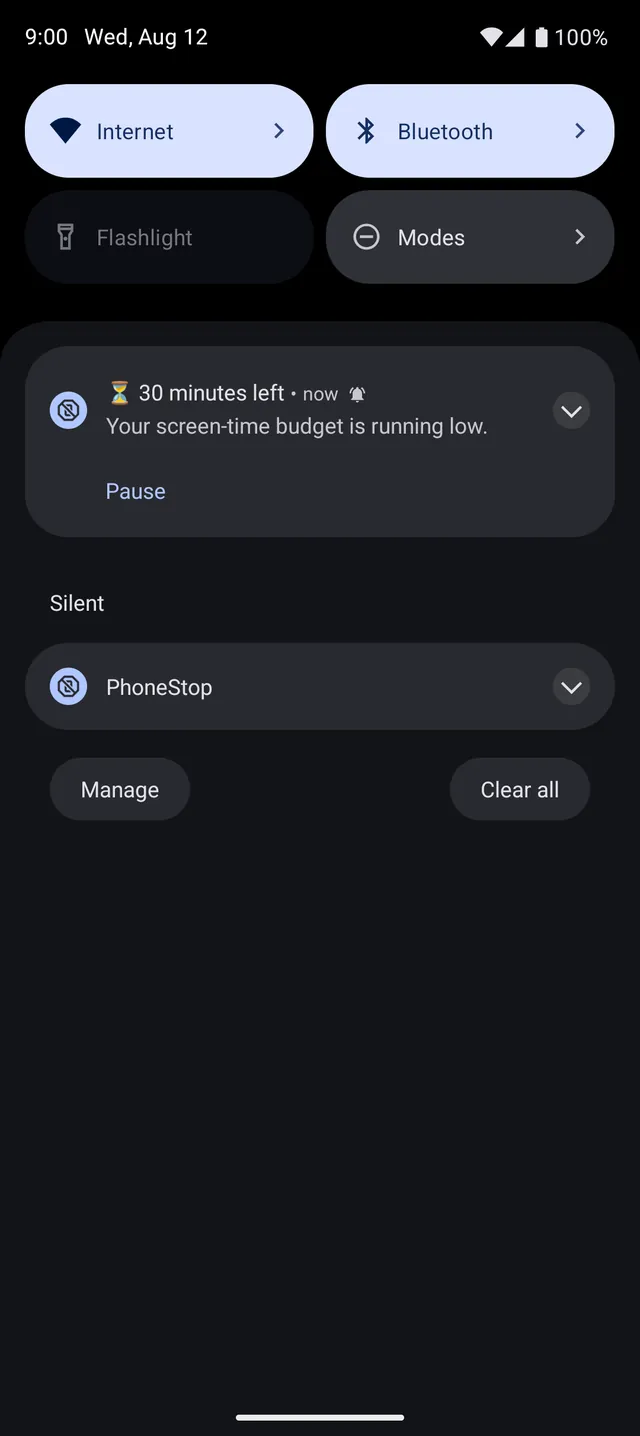
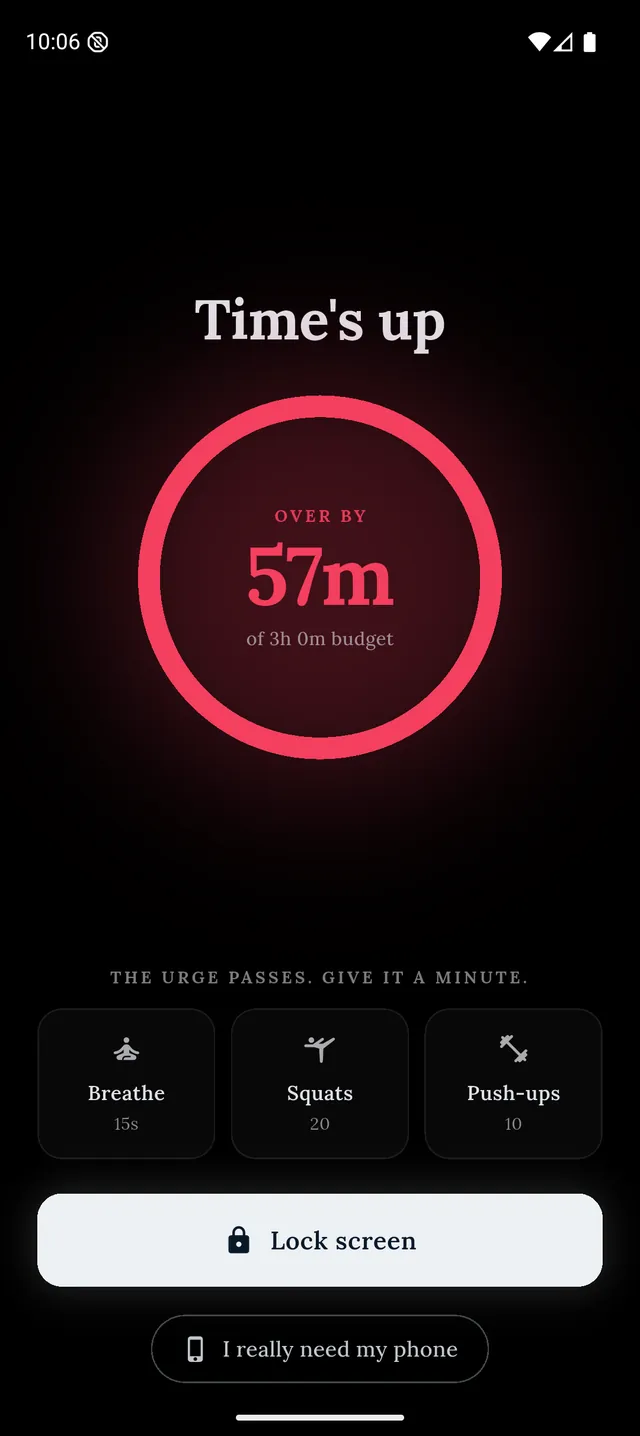
Disclosure: we make PhoneStop, so treat our own entry with the scepticism it deserves. Everything else here is written from public information and hands-on use; prices and platforms were checked in September 2026 and change often, so check the vendor before you pay.
PhoneStop is a free Android app. Set a daily screen time budget, get warned before it runs out, and get stopped when it does.
Android. No account, no ads, no data leaves your phone. An iPhone version is coming soon.
Questions people ask
Is Opal or Forest better for reducing screen time?
Opal, if you want a real block and will pay for it. Forest does not reduce access at all, it adds a small motivation on top of sessions you run yourself, so it helps only if motivation was the missing piece.
Is Forest free?
On Android it is free with in-app purchases; on iOS it is a small one-time purchase. Either way it is far cheaper than Opal, because it does much less.
Does Opal work on Android?
There is an Android build, but it trails the iPhone app that every review is based on. If you are on Android, judge it on the Android version, not the iOS screenshots.
What is the alternative to both?
A whole-phone budget that counts every app and needs no session. PhoneStop does that on Android, free, with an iPhone version coming.