PhoneStop vs Forest
Plant a tree, stay off the phone, keep the tree. The category's emotional favourite.
By Ruslan Shchuchkin, who built PhoneStop · · Read this page as Markdown
The short version
Forest and PhoneStop solve different problems and stack neatly. Use Forest to protect a block of work you chose. Use PhoneStop for the rest of the day, when nobody chose anything.
| PhoneStop | Forest | |
|---|---|---|
| Platforms | Android | iPhone, iPad, Android, browser extension |
| Price | Free | One-time purchase on iOS; free with in-app purchases on Android |
| What it does when you hit the limit | Full-screen stop, then a reset and a one-tap lock | Nothing: the tree dies if you leave your focus session |
| Warns you before the limit | Yes: at roughly 60, 30 and 10 minutes left | No |
| How it enforces | Foreground service and a display-over-apps overlay | A timed session you start yourself, with a game on top |
| Blocks individual apps | No: it budgets your whole screen time | It allows a list during a session rather than blocking one |
| Account needed | No | Optional |
| Screen time leaves the phone | No. Only anonymous taps, which you can turn off. | Optional account |
How each app stops you
Forest is positive reinforcement: start a timer, do not leave, and you are given something pretty. It is genuinely effective for study blocks and deep work.
PhoneStop is the opposite posture. It never asks you to start anything, gives you nothing to collect, and its only reward for staying under budget is that the ring is still green. When the day runs out it does the one thing Forest never does: it interrupts you.
Where Forest is the better choice
- It is a joy to use, which is not a small thing when most of this category feels like a punishment.
- One-time purchase on iOS, free on Android. No subscription resentment.
- Cross-platform, including a browser extension.
- Great for planned deep work: a study hour, a writing block, an exam week.
Where PhoneStop is the better choice
- It covers unplanned time, which is where the hours actually go.
- It measures the day, not the session, so you can see the total you keep underestimating.
- The intervention arrives on its own, at 60, 30 and 10 minutes left, and then as a full screen at zero.
- No game. Nothing to collect, nothing to lose, no streak to protect.
What PhoneStop does at the limit
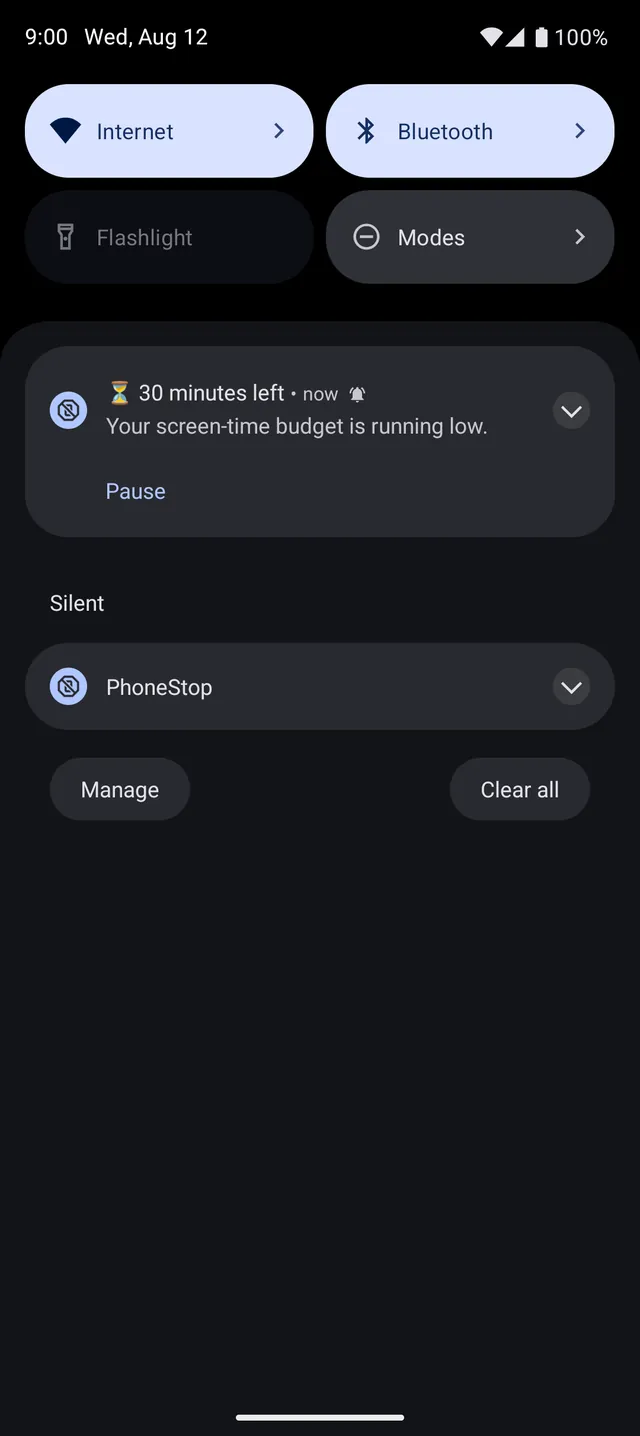
The whole product is three moments. Warnings arrive as the budget empties, inside whatever app you are in:
PhoneStop
30 minutes left
Half an hour of budget to go. A good moment to pick where it goes.
PAUSE
PhoneStop
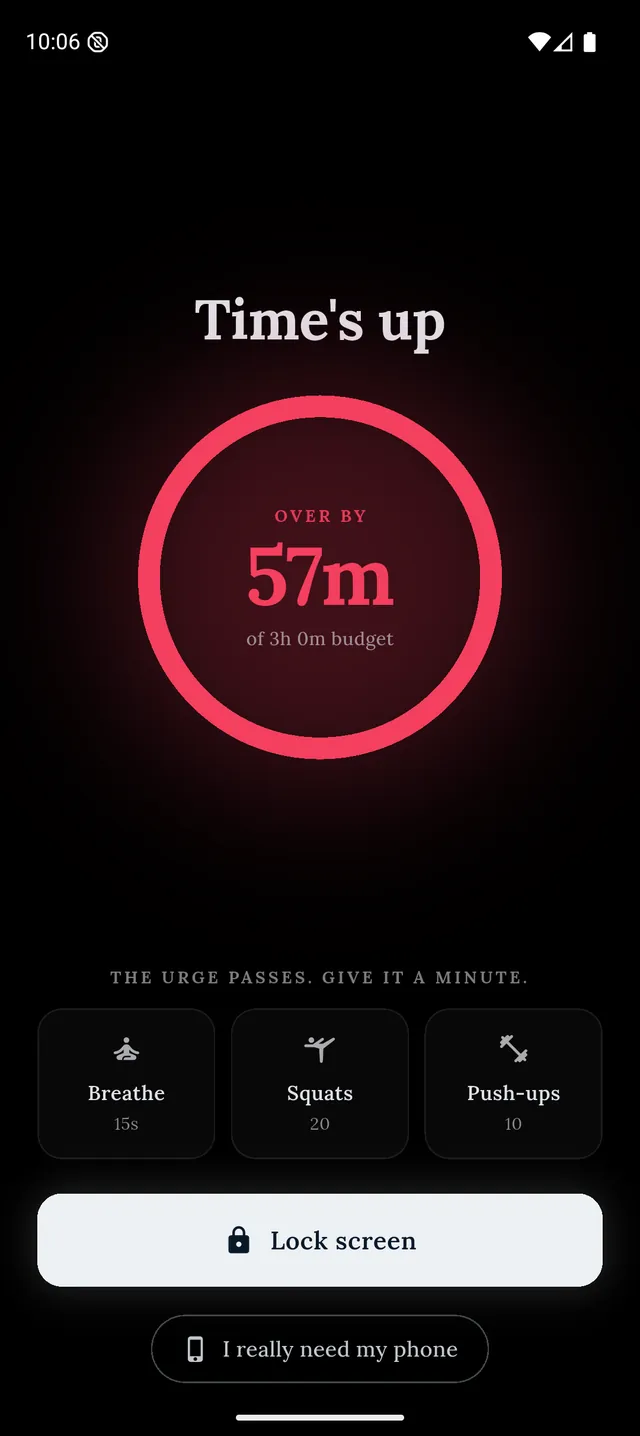
Time's up
You are out of budget for today. Take a minute, then lock the phone.
PAUSE
Then, at zero, the screen is taken over: a fifteen-second breath or twenty squats, and a button that locks the phone. If you genuinely need it, one tap extends the window and says so honestly, because an intervention you cannot escape is one you uninstall.
Disclosure: we make PhoneStop, so treat our own entry with the scepticism it deserves. Everything else here is written from public information and hands-on use; prices and platforms were checked in September 2026 and change often, so check the vendor before you pay.
PhoneStop is a free Android app. Set a daily screen time budget, get warned before it runs out, and get stopped when it does.

Android. No account, no ads. Your screen time never leaves your phone. An iPhone version is coming soon.
Questions people ask
Does Forest actually block apps?
Not in the strict sense. On Android it can notice when you leave the session and kill your tree, and you can allowlist apps you are permitted to use. It relies on you caring about the tree.
Is Forest free on Android?
The Android app is free with in-app purchases; on iPhone it is a one-time paid app. That difference is long-standing, but check the store listing before you buy.
What is a good Forest alternative for whole-day screen time?
Something that measures the day rather than a session: Android's own Digital Wellbeing, StayFree for tracking, or PhoneStop for a budget that stops you. See Forest alternatives.