Opal vs Brick
Opal charges you every year to make a block hard to lift. Brick charges you once and makes the block a thing you have to walk to.
By Ruslan Shchuchkin, who built PhoneStop · · Read this page as Markdown
The short version
Choose Opal if you want flexibility and will pay yearly for it. Schedules, categories, Deep Focus, and detailed control, all in software, near $100 a year.
Choose Brick if you have out-tapped software already. If you have installed and defeated app-based blockers, the fix is not another clever app; it is distance. A $59 puck left in another room turns an impulsive unlock into a walk.
Software if you want control; hardware if you want a wall you cannot argue with from the sofa.
| Opal | Brick | |
|---|---|---|
| Platforms | iPhone and iPad (an Android build exists but trails the iOS app) | iPhone and Android (needs recent OS versions) |
| Price | Free tier, subscription for the real features (around $100/year) | $59 one-time for the puck; the app is free |
| What it does when you hit the limit | Blocks the apps in your session; Deep Focus makes the block hard to lift | Your chosen apps are gone until you physically tap the phone on the puck |
| Warns you before the limit | Session reminders, not a whole-day countdown | No |
| How it enforces | Apple's Screen Time API | A passive NFC tag plus the OS blocking APIs |
| Blocks individual apps | Yes — per app, per website, per category | Yes — the apps disappear entirely while you are bricked |
| Account needed | Yes | Yes |
| Data leaves the device | Yes — account and cloud sync | Account |
| Google Play rating | 4.5 stars (8.77K) | 4.9 stars (4.15K) |
How each one stops you
Opal is pure software on Apple's Screen Time API: build a session, block apps and categories, and let Deep Focus raise the cost of quitting. Everything lives in the app, and everything in the app can, in principle, be changed in the app.
Brick moves the off-switch out of the phone. Your apps stay gone until you physically tap the phone on the puck, so the unlock is a physical act in physical space. That is a different kind of hard: not a harder tap, but a walk to another room.
Where Opal wins
- Flexible: schedules, categories, routines.
- No object to carry or lose.
- Deep Focus for a strong software block.
- Richer control for people who like to tune things.
Where Brick wins
- $59 once, no subscription.
- Physical distance is the strongest deterrent there is.
- Nothing to configure, tap on, tap off.
- It beats software for people who defeat software.
You are paying to make one app harder to reach
Opal and Brick answer the same question, how do I make the app harder to open, with a subscription and a puck. But both still work app by app: you nominate what to block, and the phone stays fully open for everything you did not nominate. The hours are slippery precisely because they move to whatever is not on the list.
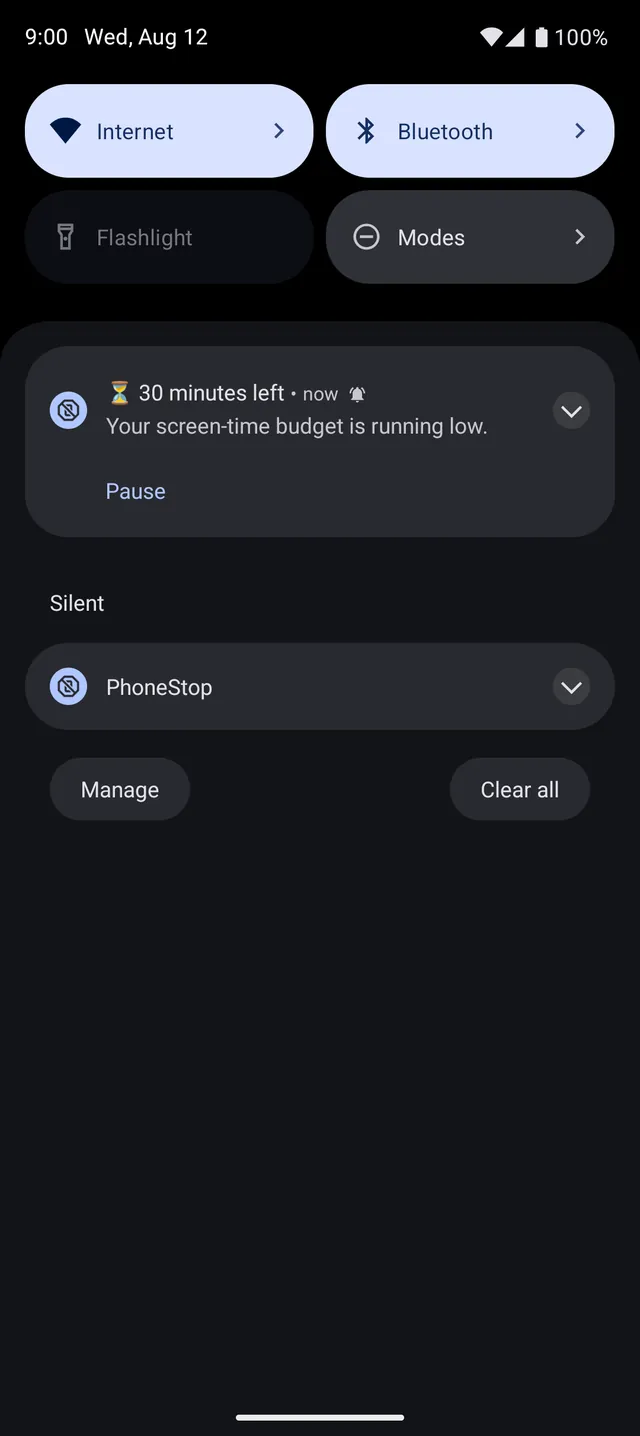
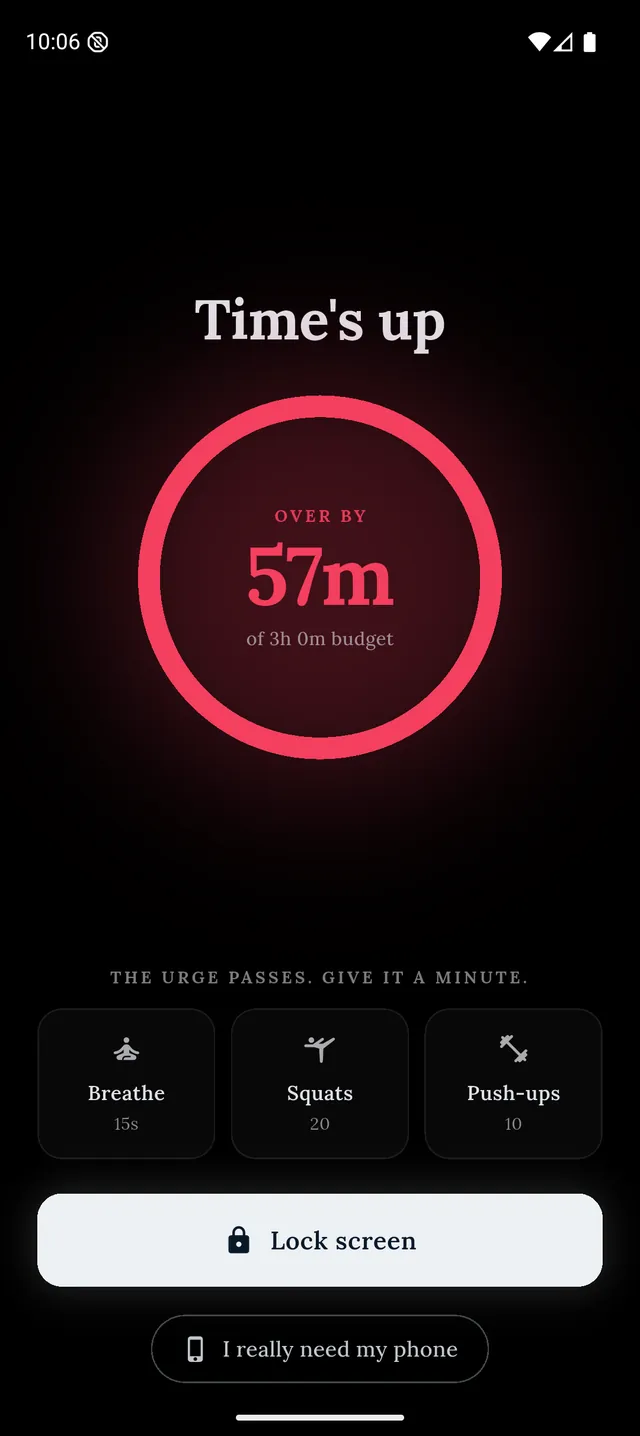
PhoneStop stops counting apps and starts counting time. One budget for the whole phone, draining as you use it, with a stop when it is gone. No yearly fee, no object, no blocklist to keep guessing at. Free on Android, iPhone coming, and it cannot block a single app on purpose.
Disclosure: we make PhoneStop, so treat our own entry with the scepticism it deserves. Everything else here is written from public information and hands-on use; prices and platforms were checked in September 2026 and change often, so check the vendor before you pay.
PhoneStop is a free Android app. Set a daily screen time budget, get warned before it runs out, and get stopped when it does.
Android. No account, no ads, no data leaves your phone. An iPhone version is coming soon.
Questions people ask
Opal or Brick for phone addiction?
Brick, if software blockers have stopped working on you, the physical unlock is harder to cheat. Opal, if you want flexible, schedulable software and will pay the subscription.
Is Brick a subscription?
No. Brick is $59 once for the puck, and the app is free. Opal's real features are a subscription near $100 a year.
Does Opal need the phone to be a certain platform?
Opal is iPhone-first; its Android build trails. Brick works on both iPhone and Android with recent OS versions.