one sec vs ScreenZen
Both put a moment between you and the app. one sec has the research and the polish; ScreenZen does nearly the same thing for nothing.
By Ruslan Shchuchkin, who built PhoneStop · · Read this page as Markdown
The short version
Choose one sec if the breath is the whole point. Its enforced pause before an app opens is the most studied intervention in this category, and it is beautifully done. Going past one app costs a subscription, around $50 a year.
Choose ScreenZen if you want the same idea for free. It also pauses you, asks for a reason, and can refuse the open after a cap, across as many apps as you like, on iPhone and Android, donation-supported.
If money were no object it would be close. It is not, and ScreenZen does most of what one sec does for zero.
| one sec | ScreenZen | |
|---|---|---|
| Platforms | iPhone, iPad, Android, browser extension | iPhone, iPad, Android |
| Price | Free for one app; subscription to go further (around $50/year) | Free, donation-supported |
| What it does when you hit the limit | There is no daily limit — it interrupts each time you open the app | Shows a pause screen and can refuse the open once you pass your cap |
| Warns you before the limit | No | Per-app, at the moment you open the app |
| How it enforces | iOS Shortcuts automations; an accessibility service on Android | Apple's Screen Time API; an accessibility service on Android |
| Blocks individual apps | It delays them, and can stop opens after a count you set | Yes — a delay, an intention prompt and an open limit per app |
| Account needed | Optional | No |
| Data leaves the device | Optional account | No |
| Google Play rating | 4.7 stars (45.9K) | 4.7 stars (32.2K) |
How each one stops you
one sec triggers a mandatory pause the moment you open a watched app, a breath, a short wait, a chance to change your mind, and can stop the open after a count you set. On iOS it runs through Shortcuts automations; on Android through an accessibility service.
ScreenZen works the same seam: a pause screen, an intention prompt, and an open limit per app. It leans on Apple's Screen Time API on iOS and an accessibility service on Android. The mechanics are close enough that the real question is the price and the polish, not the method.
Where one sec wins
- The evidence. one sec's pause has actual published research behind it.
- The craft. The interruption is the most refined in the category.
- A browser extension, so the desktop is covered too.
Where ScreenZen wins
- It is free, where one sec charges ~$50/year past the first app.
- Every app, not one, without paying to unlock more.
- A firm cap, not only a breath, it can refuse the open.
- No account. Nothing leaves the device.
A pause per app still needs you to name the apps
one sec and ScreenZen both interrupt you app by app. That means the protection only covers the apps you thought to add, and the habit is free to walk to the one you did not. You breathe before Instagram, then open the browser instead, and neither app says a word.
The number that cannot be walked around is the total. PhoneStop budgets your whole phone at once, so the ten minutes you saved by breathing before one app are not quietly spent inside another. It is free on Android, with iPhone coming, and it pauses the whole day rather than each icon. See why blocking one app does not lower your screen time.
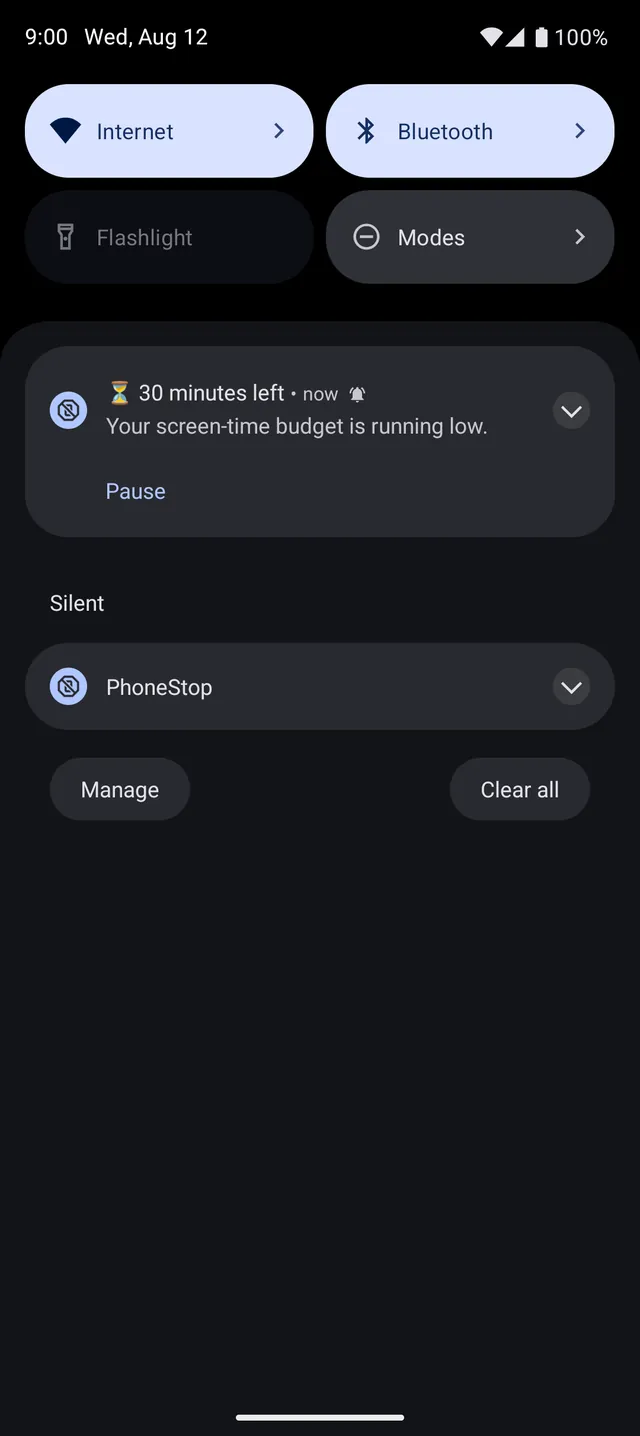
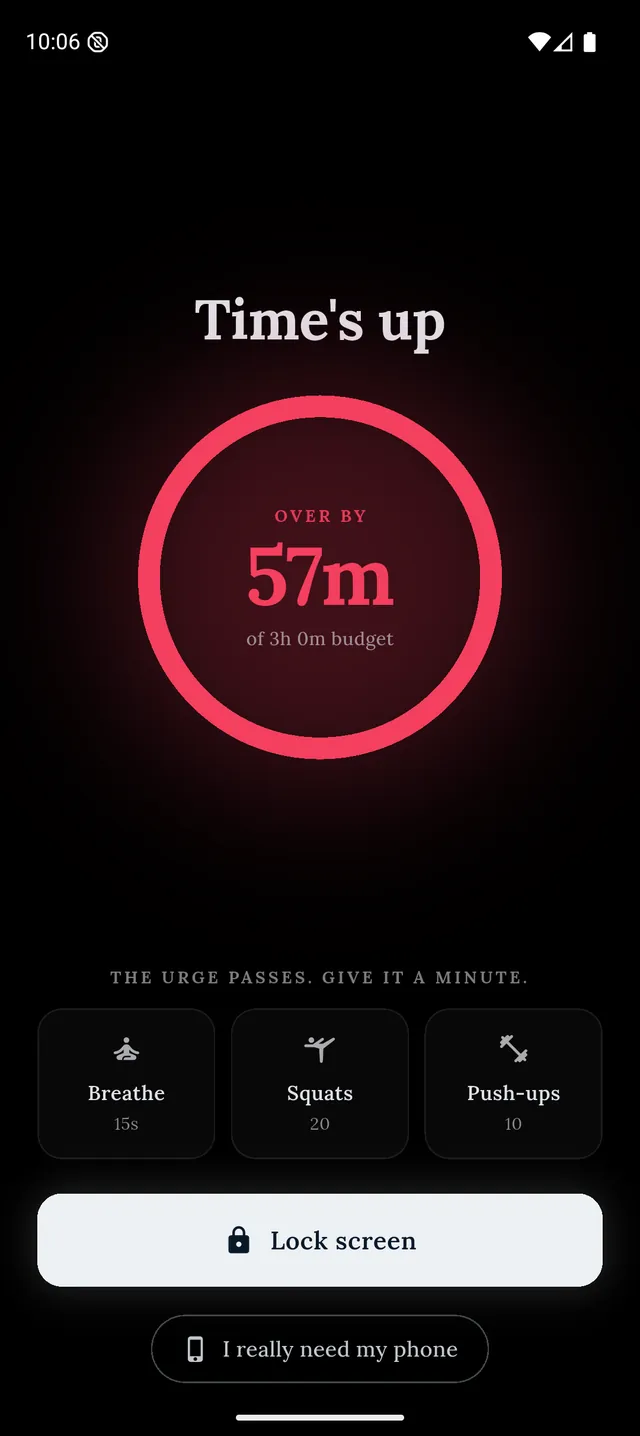
Disclosure: we make PhoneStop, so treat our own entry with the scepticism it deserves. Everything else here is written from public information and hands-on use; prices and platforms were checked in September 2026 and change often, so check the vendor before you pay.
PhoneStop is a free Android app. Set a daily screen time budget, get warned before it runs out, and get stopped when it does.

Android. No account, no ads, no data leaves your phone. An iPhone version is coming soon.
Questions people ask
Is ScreenZen as good as one sec?
For most people, yes, and it is free. one sec has better research and a more polished pause; ScreenZen does the same job across every app without a subscription.
Is one sec worth paying for?
If you want the single best-studied pause and will use it on one or two apps, it is a fair price. If you want it on many apps, the yearly cost adds up fast against free ScreenZen.
Do either of them limit total screen time?
No. Both act per app, at the moment you open one. Neither keeps a running total for the whole phone, which is what PhoneStop does.
Which works on Android?
Both do, through an accessibility service. ScreenZen is the stronger free choice there.