PhoneStop vs one sec
A breath before the app opens. The purest friction app, and the one with the best evidence behind it.
By Ruslan Shchuchkin, who built PhoneStop · · Read this page as Markdown
The short version
These two are complements more than rivals, and running both is a reasonable answer. If you only want one: pick one sec if your problem is compulsive opening: you unlock, tap Instagram, and only then wonder why. Pick PhoneStop if your problem is the length of the sessions once they start.
| PhoneStop | one sec | |
|---|---|---|
| Platforms | Android | iPhone, iPad, Android, browser extension |
| Price | Free | Free for one app; subscription to go further (around $50/year) |
| What it does when you hit the limit | Full-screen stop, then a reset and a one-tap lock | There is no daily limit: it interrupts each time you open the app |
| Warns you before the limit | Yes: at roughly 60, 30 and 10 minutes left | No |
| How it enforces | Foreground service and a display-over-apps overlay | iOS Shortcuts automations; an accessibility service on Android |
| Blocks individual apps | No: it budgets your whole screen time | It delays them, and can stop opens after a count you set |
| Account needed | No | Optional |
| Screen time leaves the phone | No. Only anonymous taps, which you can turn off. | Optional account |
How each app stops you
one sec's mechanism is a proven one: put a few seconds and a deep breath between the reach and the reward, and a meaningful share of opens simply stop happening. It is the least paternalistic thing in this category.
PhoneStop works at the other end. It assumes you will open the app (you always do) and asks a different question: how much of today has already gone. The budget drains, the warnings escalate, and at zero the screen is taken over. One app is trying to stop the reach; the other is trying to end the session.
Where one sec is the better choice
- The research. one sec's pause-before-open model has actual published evidence behind it.
- It is on iPhone, and it works well there. PhoneStop is Android only, with an iPhone version coming soon.
- It is per-app, so your maps and your bank are never touched.
- It is gentler. Nothing is ever taken away from you; you are only ever asked to wait.
Where PhoneStop is the better choice
- It covers the session, not the doorway. The hour you lose after tapping through is the hour PhoneStop is built for.
- Free, all of it.
- No accessibility service and no Shortcuts. PhoneStop uses a foreground service and the display-over-apps permission, so nothing reads your screen.
- One setup, whole phone. There is no per-app list to maintain.
What PhoneStop does at the limit
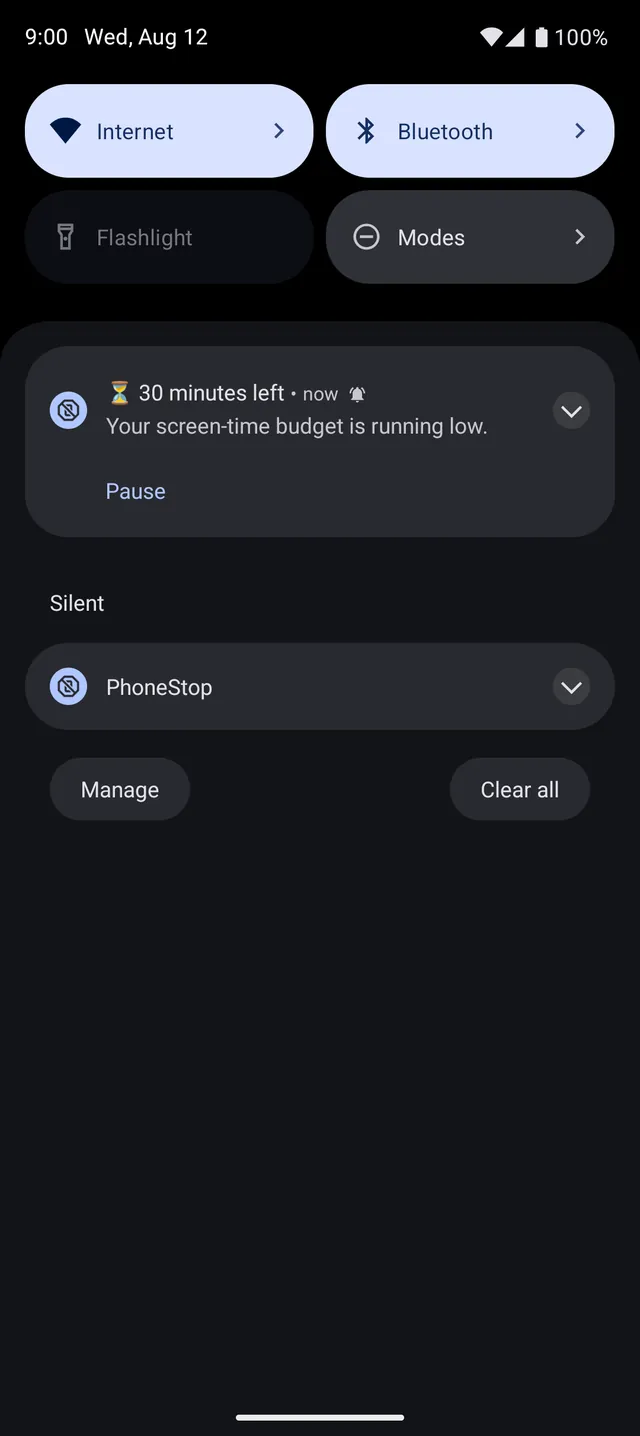
The whole product is three moments. Warnings arrive as the budget empties, inside whatever app you are in:
PhoneStop
30 minutes left
Half an hour of budget to go. A good moment to pick where it goes.
PAUSE
PhoneStop
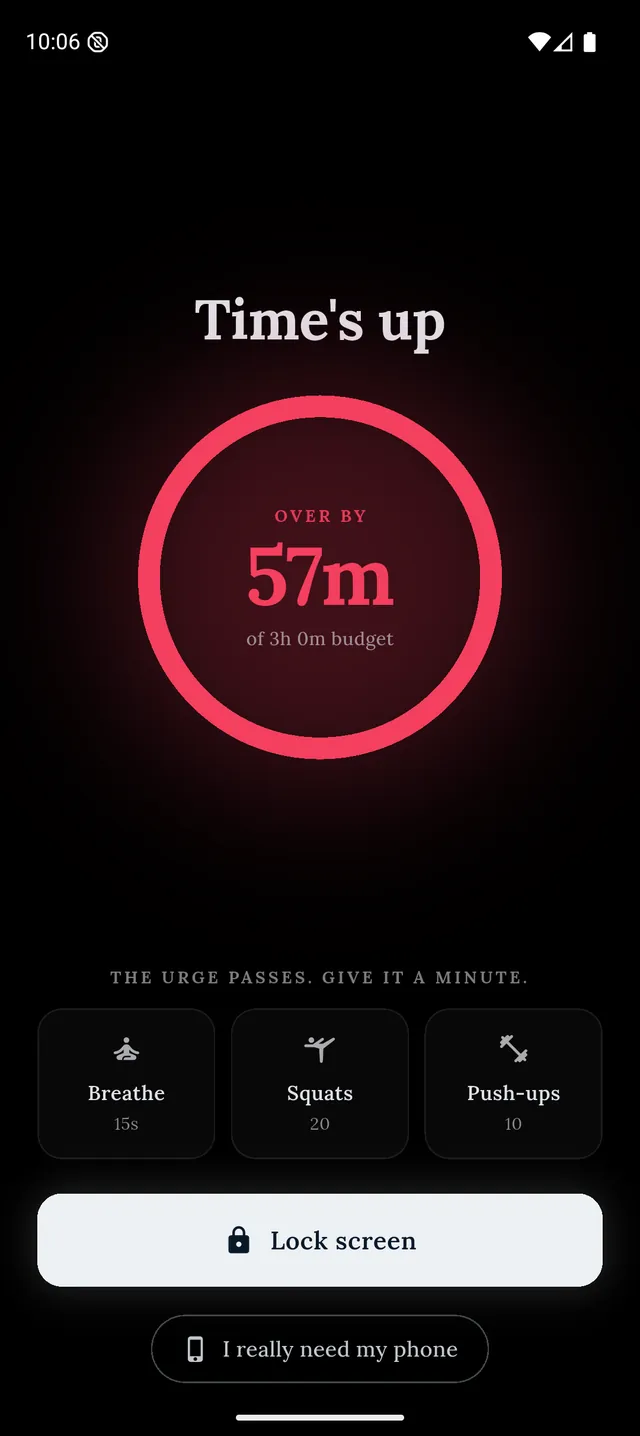
Time's up
You are out of budget for today. Take a minute, then lock the phone.
PAUSE
Then, at zero, the screen is taken over: a fifteen-second breath or twenty squats, and a button that locks the phone. If you genuinely need it, one tap extends the window and says so honestly, because an intervention you cannot escape is one you uninstall.
Disclosure: we make PhoneStop, so treat our own entry with the scepticism it deserves. Everything else here is written from public information and hands-on use; prices and platforms were checked in September 2026 and change often, so check the vendor before you pay.
PhoneStop is a free Android app. Set a daily screen time budget, get warned before it runs out, and get stopped when it does.

Android. No account, no ads. Your screen time never leaves your phone. An iPhone version is coming soon.
Questions people ask
Does one sec work on Android?
Yes. On Android it uses an accessibility service to notice the app launch and draw the breathing screen over it. On iPhone it uses Shortcuts automations instead.
Is one sec free?
There is a free tier limited to a single app. Unlimited apps and the analytics sit behind a subscription of roughly $50 a year, checked August 2026.
Can I use one sec and PhoneStop together?
Yes, and they do not fight: one sec interrupts the app opening, PhoneStop counts total screen time and steps in at the end of the budget.