one sec vs Opal
one sec asks you to wait. Opal refuses to open the door. The choice is really between friction and force.
By Ruslan Shchuchkin, who built PhoneStop · · Read this page as Markdown
The short version
Choose one sec if a moment of friction is enough for you. The enforced breath stops most impulse opens, it keeps you in charge, and there is nothing to rebel against. Past one app it is around $50 a year.
Choose Opal if friction is not enough and you want a wall. Deep Focus makes the block genuinely hard to lift, which is what some people need. It is the pricier of the two, near $100 a year.
Pick friction if your problem is autopilot. Pick the wall if your problem is willpower.
| one sec | Opal | |
|---|---|---|
| Platforms | iPhone, iPad, Android, browser extension | iPhone and iPad (an Android build exists but trails the iOS app) |
| Price | Free for one app; subscription to go further (around $50/year) | Free tier, subscription for the real features (around $100/year) |
| What it does when you hit the limit | There is no daily limit — it interrupts each time you open the app | Blocks the apps in your session; Deep Focus makes the block hard to lift |
| Warns you before the limit | No | Session reminders, not a whole-day countdown |
| How it enforces | iOS Shortcuts automations; an accessibility service on Android | Apple's Screen Time API |
| Blocks individual apps | It delays them, and can stop opens after a count you set | Yes — per app, per website, per category |
| Account needed | Optional | Yes |
| Data leaves the device | Optional account | Yes — account and cloud sync |
| Google Play rating | 4.7 stars (45.9K) | 4.5 stars (8.77K) |
How each one stops you
one sec inserts a pause and can cap opens; it is deliberately gentle, and it lets you through if you still choose to go. Opal builds a session and blocks the apps in it, with Deep Focus turning the block from a speed bump into a barrier. Both lean on Apple's Screen Time API on iPhone, where each is at its best.
So the mechanism difference is the whole story: one sec slows the door, Opal locks it.
Where one sec wins
- Cheaper, and free for a single app.
- Cross-platform and calmer, a breath, not a battle.
- The best evidence behind its pause.
- Nothing to resent, so it survives bad days.
Where Opal wins
- A real block, not just a delay.
- Deep Focus for when you cannot be trusted with an override.
- Per app, website and category control.
- Schedules for recurring focus.
Friction or force, both are aimed at single apps on the iPhone
one sec and Opal are the two best-known iPhone-first tools, and they sit at opposite ends of the same street: one slows the app, the other bars it. But both are pointed at individual apps you nominate, and both leave the rest of the phone wide open. Slow down Instagram, wall off TikTok, and the evening still finds Reddit, or YouTube, or the news.
PhoneStop takes the other route entirely: no per-app friction and no per-app wall, just one budget for the whole phone that every app draws down. It is free on Android today, with an iPhone version on the way, and it is built for the case both of these miss, the app you did not think to add.
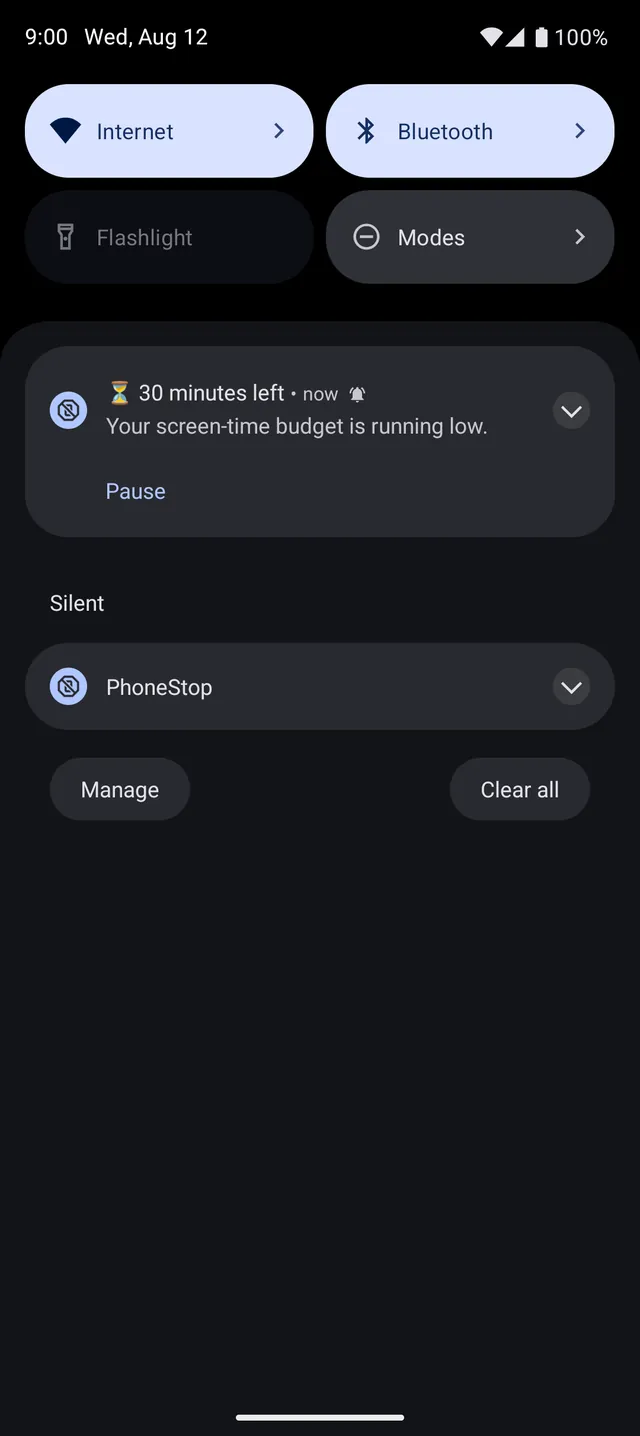
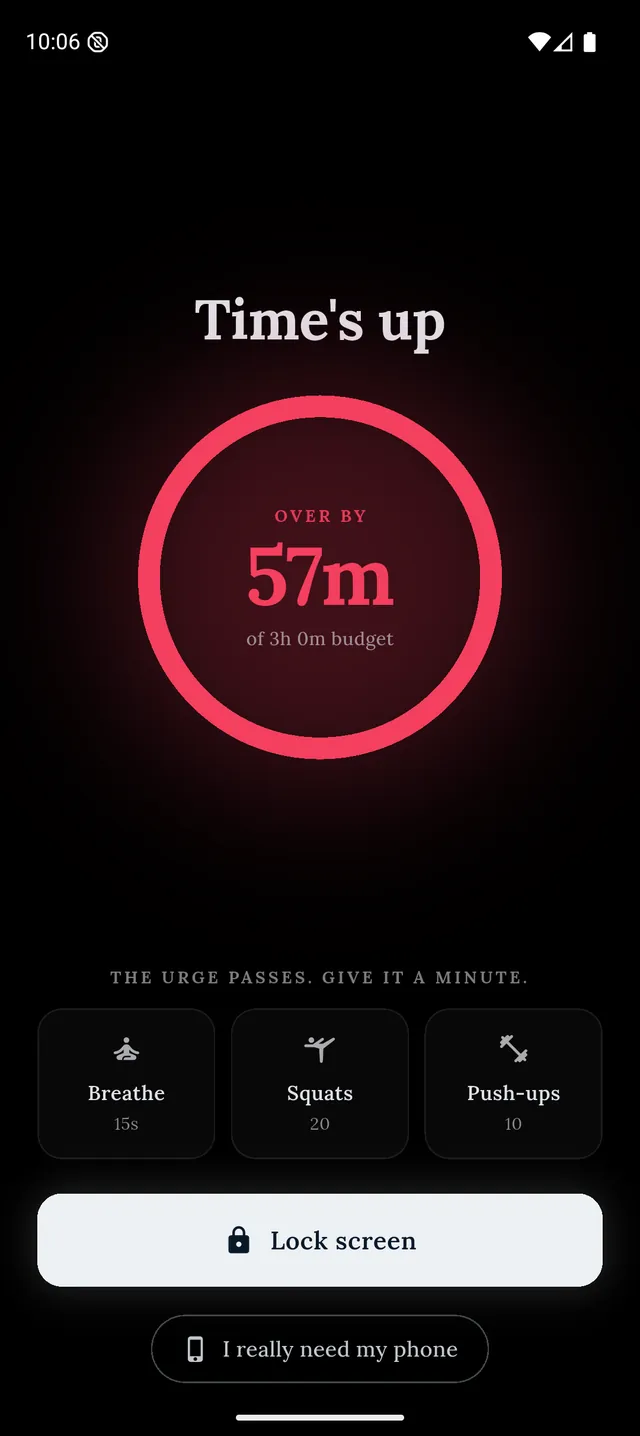
Disclosure: we make PhoneStop, so treat our own entry with the scepticism it deserves. Everything else here is written from public information and hands-on use; prices and platforms were checked in September 2026 and change often, so check the vendor before you pay.
PhoneStop is a free Android app. Set a daily screen time budget, get warned before it runs out, and get stopped when it does.
Android. No account, no ads, no data leaves your phone. An iPhone version is coming soon.
Questions people ask
one sec or Opal, which reduces screen time more?
Opal enforces harder, so it cuts access more directly; one sec changes the habit more gently and is cheaper. Heavy compulsion leans Opal; autopilot scrolling leans one sec.
Are both iPhone-only?
Both are iPhone-first. one sec also has a solid Android app and a browser extension; Opal's Android build trails its iOS version.
Do either cap my whole day?
No. Both act on the apps you choose, one by one. A whole-phone daily budget is what PhoneStop adds.