Brick vs Foqos
Both lock your apps behind an NFC tap. Brick sells you the puck for $59; Foqos is free and open source, and works with any cheap tag you already have.
By Ruslan Shchuchkin, who built PhoneStop · · Read this page as Markdown
The short version
Choose Foqos if you are on iPhone and want this for nothing. It is free, open source, and does the same job as Brick using a cheap NFC tag or even a printed QR code. There is no account and nothing leaves your phone.
Choose Brick if you want a finished object and cross-platform support. It is a designed puck, it works on iPhone and Android, and for some people paying $59 for a single tidy device beats sourcing tags and setting up open-source software.
If you are on iPhone and comfortable with a little setup, Foqos gives you Brick's mechanism for free.
| Brick | Foqos | |
|---|---|---|
| Platforms | iPhone and Android (needs recent OS versions) | iPhone (uses Apple's Screen Time API) |
| Price | $59 one-time for the puck; the app is free | Free and open source |
| What it does when you hit the limit | Your chosen apps are gone until you physically tap the phone on the puck | Your blocked apps stay gone until you tap an NFC tag or scan a QR code to unlock |
| Warns you before the limit | No | No |
| How it enforces | A passive NFC tag plus the OS blocking APIs | Apple's Screen Time API, flipped by a cheap NFC tag or a printable QR code |
| Blocks individual apps | Yes — the apps disappear entirely while you are bricked | Yes, apps and websites, through Screen Time |
| Account needed | Yes | No |
| Data leaves the device | Account | No, everything stays on the iPhone |
| Google Play rating | 4.9 stars (4.15K) | Not on Google Play |
How each one stops you
Both flip a block that lives in the operating system. Foqos uses Apple's Screen Time API and lets any NFC tag, or a QR code, act as the physical switch, so the hardware cost is a few cents. Brick pairs its own puck with the same kind of OS-level blocking, and sells the puck as a single polished product on both platforms.
The enforcement is the same idea; the difference is whether you buy a finished device or assemble the free version yourself.
Where Brick wins
- A designed, single object rather than a loose tag.
- iPhone and Android, where Foqos is iPhone-only.
- Nothing to set up beyond the app and the puck.
- Support and a warranty behind a physical product.
Where Foqos wins
- Free and open source, against Brick's $59.
- Any cheap NFC tag or a printed QR code works.
- No account, nothing leaves the phone.
- Auditable code, for people who want to see what it does.
The cheapest version is still an iPhone-only toggle
Foqos proves the mechanism costs almost nothing, which is worth knowing. But it is iPhone-only, and both it and Brick are still a switch you flip for a set of apps you chose, leaving the rest of the phone open and keeping no count of your day. If you are on Android, Foqos is not even on the table.
PhoneStop is the Android answer, and it works differently on purpose: one daily budget for the whole phone, drained by every app, with a warning before it runs out and a stop when it is gone. It is free, needs no tag, and an iPhone version is coming. The saving with Foqos is real; it just does not change what is being measured.
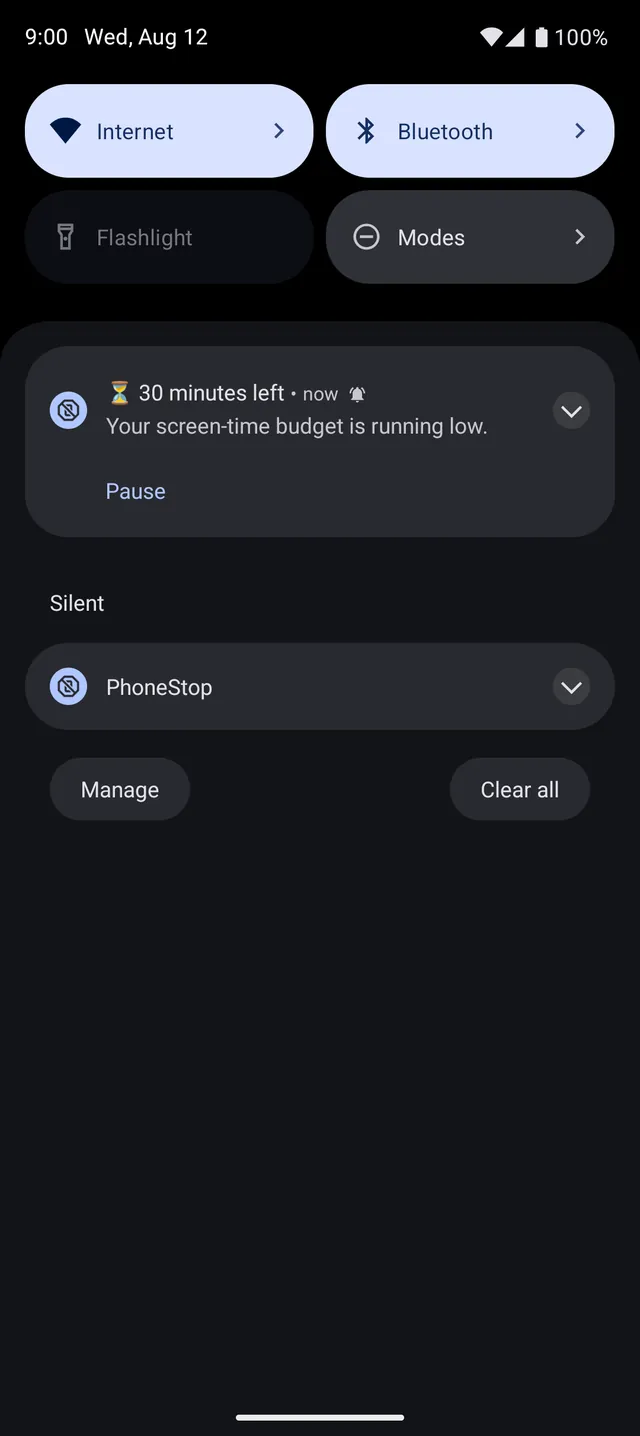
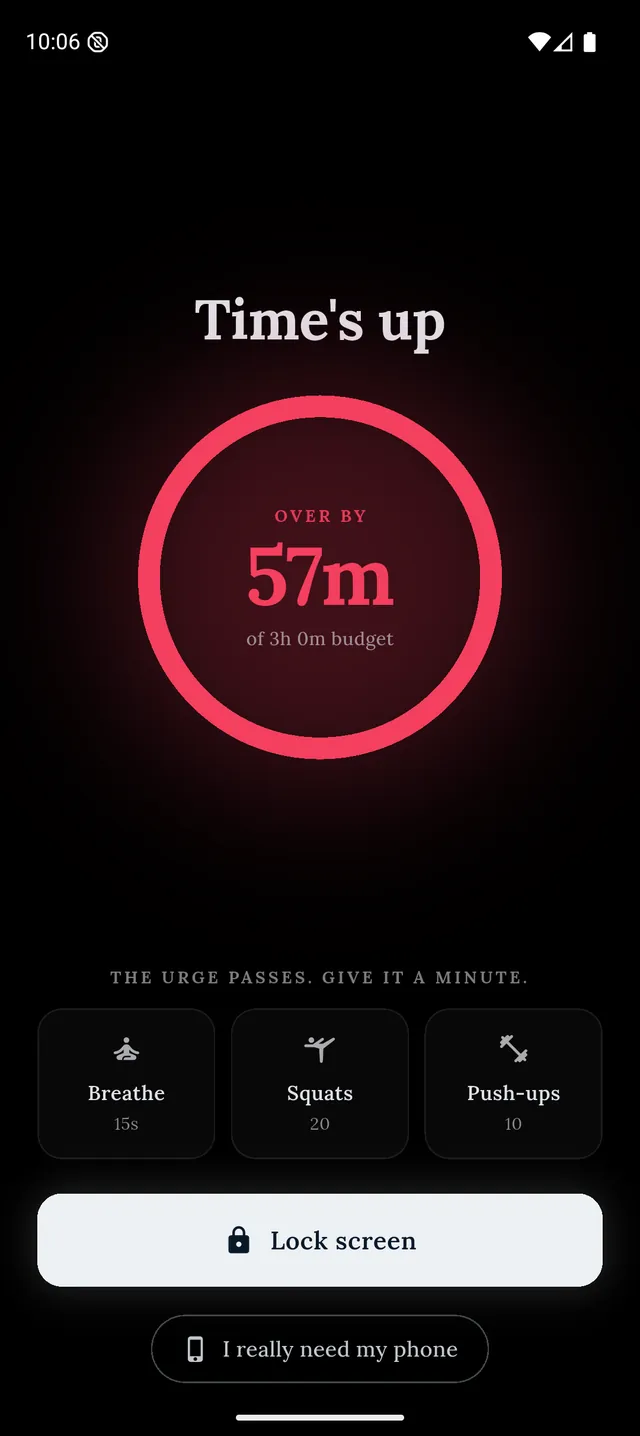
Disclosure: we make PhoneStop, so treat our own entry with the scepticism it deserves. Everything else here is written from public information and hands-on use; prices and platforms were checked in September 2026 and change often, so check the vendor before you pay.
PhoneStop is a free Android app. Set a daily screen time budget, get warned before it runs out, and get stopped when it does.
Android. No account, no ads, no data leaves your phone. An iPhone version is coming soon.
Questions people ask
Is Foqos really a free Brick?
Close to it, on iPhone. It uses Apple's Screen Time API and any cheap NFC tag or a QR code to flip the block, with no account and no fee. Brick sells a finished puck and also runs on Android.
Does Foqos work on Android?
No, it is iPhone-only. Brick works on both. On Android, a whole-phone budget like PhoneStop is the closest equivalent that needs no hardware.
Is the $59 for Brick worth it over Foqos?
Only for the finished object and Android support. The blocking itself is the same idea, and Foqos does it for free on iPhone.