BePresent vs Opal
The two big iPhone screen time subscriptions, at roughly the same price, betting on opposite theories of why you fail.
By Ruslan Shchuchkin, who built PhoneStop · · Read this page as Markdown
The short version
Choose BePresent if you fail alone. Its whole thesis is social: streaks, XP, a leaderboard, and accountability partners who get a message when you miss your goal. If every quiet tracker you have installed lasted a fortnight, that is the missing ingredient and it is worth the money.
Choose Opal if you want the block itself to be stronger. Deep Focus is genuinely difficult to lift in the moment, the app is the more finished of the two, and nothing about it requires you to involve another human being.
At roughly $60 a year each, the price is not the deciding factor. The deciding factor is whether being watched helps you or exhausts you, and you probably already know which.
| BePresent | Opal | |
|---|---|---|
| Platforms | iPhone and iPad, with an Android app that trails it | iPhone and iPad (an Android build exists but trails the iOS app) |
| Price | Seven-day trial, then a subscription (around $60/year) | Free tier, subscription for the real features (around $100/year) |
| What it does when you hit the limit | Blocks the apps in your session, and tells your accountability partners if you miss a goal | Blocks the apps in your session; Deep Focus makes the block hard to lift |
| Warns you before the limit | Awareness nudges while you scroll, not a whole-day countdown | Session reminders, not a whole-day countdown |
| How it enforces | Apple's Screen Time API, plus a social layer | Apple's Screen Time API |
| Blocks individual apps | Yes: during sessions you schedule | Yes: per app, per website, per category |
| Account needed | Yes: the social half requires one | Yes |
| Data leaves the device | Yes: account, leaderboards and shared progress | Yes: account and cloud sync |
| Google Play rating | 4.8 stars (9.2K) | 4.5 stars (8.77K) |
How each one stops you
Both are built on Apple's Screen Time API, so the underlying block is the same machinery. Everything that differs is what they wrap around it.
Opal wraps it in strength. You start a session or let a schedule start one, chosen apps stop opening, and Deep Focus removes the way out. The paid tier is essentially a promise that you will not be able to change your mind for the next hour.
BePresent wraps it in social pressure. You schedule present sessions, and the app runs the same psychology as the products you are trying to escape: a streak to protect, experience points, a ranking among friends, and partners who are told when you slip. The block is ordinary; the reason you honour it is not.
One makes the wall higher. The other makes you care about not walking to it.
Where BePresent wins
- Accountability partners are a real mechanism, and nothing else in this category offers them.
- It survives week two, which is where most screen time apps are uninstalled.
- Group sessions work well for couples, families and study groups.
- The rewards programme gives some people a concrete external reason to continue.
- Gamification is an honest answer to the fact that quiet trackers get ignored.
Where Opal wins
- Deep Focus is the harder block, by a clear margin.
- The more polished product: onboarding, charts and session presets are a step ahead.
- It works entirely alone. No partners, no leaderboard, nobody told anything.
- Per-app and per-category control that is genuinely granular.
- It does not ask your friends to pay too, which BePresent's best features effectively do.
Both of them go quiet when no session is running
Strip away the leaderboard and the Deep Focus lock and these two share a shape: you decide in advance when you are going to have a problem. A session, a schedule, a present block. Set it up and the app holds the line.
The trouble is that nobody schedules the evening that goes wrong. It is a Tuesday, nothing was planned, you picked the phone up at nine to check one thing, and it is now half past eleven. No session was running, so neither app said a word, and no streak was broken either, because you never committed to anything that night.
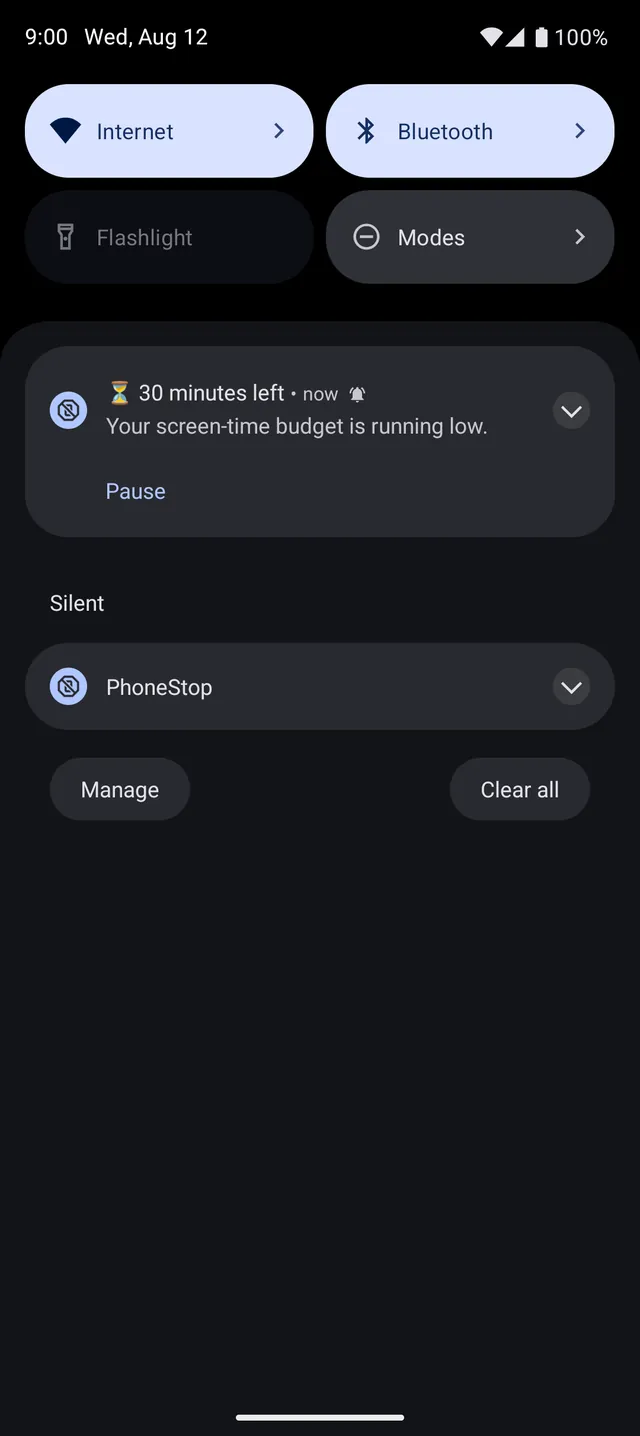
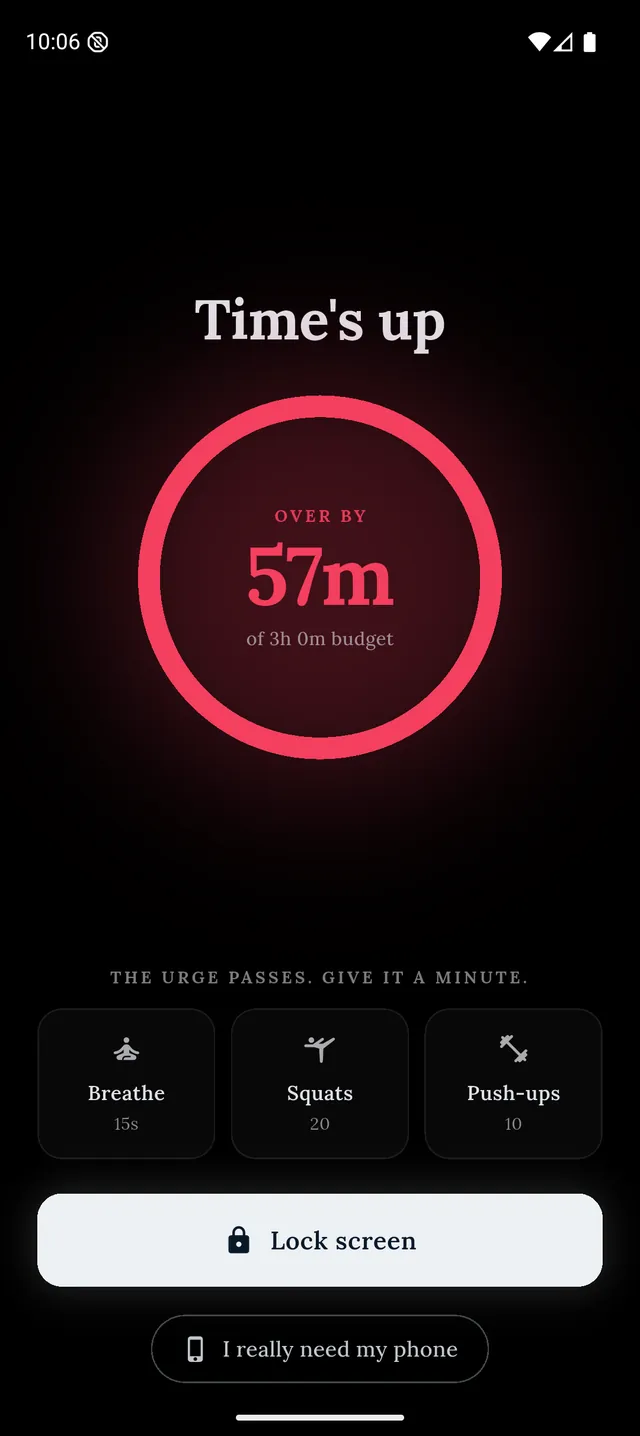
That gap is the whole reason PhoneStop is built the other way round. The budget is always running. There is nothing to start, nothing to schedule, and no plan to remember, so an unplanned evening is exactly as covered as a planned one. It counts every minute the screen is on, warns you at roughly sixty, thirty and ten minutes left inside whatever app you are using, and takes the screen at zero.
It is also free, holds no account, and has no leaderboard, which for some people reading a BePresent review is the actual selling point. The catch is honest: it is Android today, with an iPhone version in progress. If you are choosing between these two on an iPhone this week, Opal or BePresent is your answer and this paragraph is a bookmark.
Disclosure: we make PhoneStop, so treat our own entry with the scepticism it deserves. Everything else here is written from public information and hands-on use; prices and platforms were checked in September 2026 and change often, so check the vendor before you pay.
PhoneStop is a free Android app. Set a daily screen time budget, get warned before it runs out, and get stopped when it does.
Android. No account, no ads. Your screen time never leaves your phone. An iPhone version is coming soon.
Questions people ask
Is BePresent or Opal better?
BePresent if accountability and gamification keep you going; Opal if you want the stronger block and would rather not involve anyone else. They cost about the same, so it is a question about you.
Are BePresent and Opal the same price?
Both land near $60 a year, though Opal's pricing runs higher on some plans. Both start with a short trial that converts automatically, so set a reminder if you are only testing.
Do my friends need to pay for BePresent too?
For the social features, yes. Partners, groups and leaderboards need other people inside the app on their own subscriptions, which makes the real cost a multiple of the sticker price.
Is there a free alternative to both?
ScreenZen is free on both platforms with no paid tier, and Android's Digital Wellbeing costs nothing. See Opal alternatives and BePresent alternatives.