PhoneStop vs minimalist phone
A grey text-only home screen. It removes the pull of the icon rather than blocking anything.
By Ruslan Shchuchkin, who built PhoneStop · · Read this page as Markdown
The short version
This is the one comparison on the site where the answer is genuinely both. They do not overlap: minimalist phone makes you reach for the phone less often, PhoneStop makes the reaches shorter. If you can only run one, pick by your own honest failure: if you pick the phone up forty times a day out of reflex, the launcher is your fix; if you pick it up ten times and lose an hour each time, a budget is.
| PhoneStop | minimalist phone | |
|---|---|---|
| Platforms | Android | Android (it is a launcher; iPhone does not allow them) |
| Price | Free | Seven-day trial, then a subscription or a one-time purchase (around $25 for lifetime) |
| What it does when you hit the limit | Full-screen stop, then a reset and a one-tap lock | Nothing by default: it changes what the phone looks like, not what it allows |
| Warns you before the limit | Yes: at roughly 60, 30 and 10 minutes left | No |
| How it enforces | Foreground service and a display-over-apps overlay | A replacement home screen, with greyscale and app delays |
| Blocks individual apps | No: it budgets your whole screen time | It hides them behind a text list and a delay |
| Account needed | No | No |
| Screen time leaves the phone | No. Only anonymous taps, which you can turn off. | No |
How each app stops you
These two work on opposite ends of the same habit. minimalist phone attacks the cue: the bright icon, the badge, the home screen that suggests something is waiting. Strip that away and a large share of pickups never start, which is a real effect and the cheapest one available.
PhoneStop attacks the session: the pickup that did start and then did not end. It counts every minute the screen is on, warns you as the budget drains, and puts a full screen in front of you at zero. It has nothing to say about your home screen and does not want to change it.
So the honest framing is not either-or. If the launcher is working for you, keep it; a budget underneath it covers the half it structurally cannot reach.
Where minimalist phone is the better choice
- The best answer to the reach of anything on this site, and it is close to free for life.
- Greyscale and notification filtering in one place, without rooting or fighting the OS.
- It is quiet. No streaks, no scores, no notifications telling you how you did.
- No account and no data collection.
- A one-time purchase option that costs less than most of the category charges per year.
Where PhoneStop is the better choice
- It has an opinion about how much is too much. A launcher never will.
- It acts during the session, which is where the hours are actually lost.
- Free.
- It leaves your phone alone. No new home screen, no relearning where anything is.
- It measures, so at the end of a week you have a number rather than an impression.
What PhoneStop does at the limit
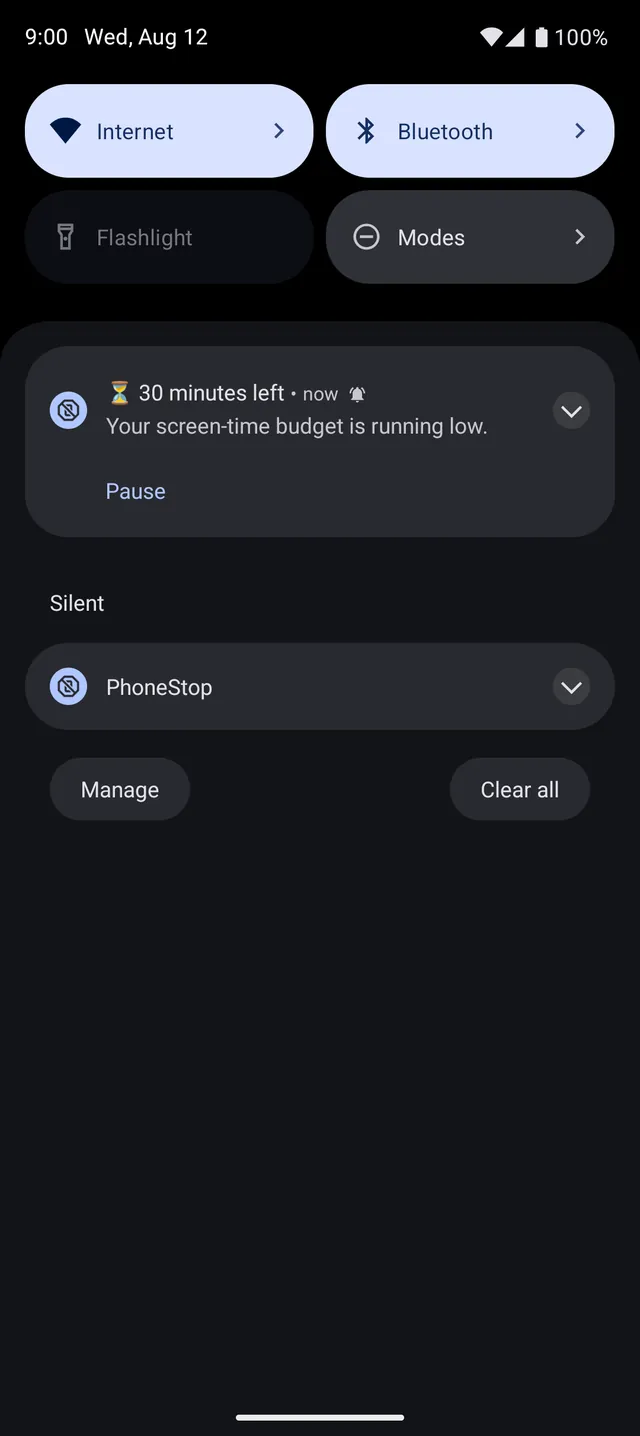
The whole product is three moments. Warnings arrive as the budget empties, inside whatever app you are in:
PhoneStop
30 minutes left
Half an hour of budget to go. A good moment to pick where it goes.
PAUSE
PhoneStop
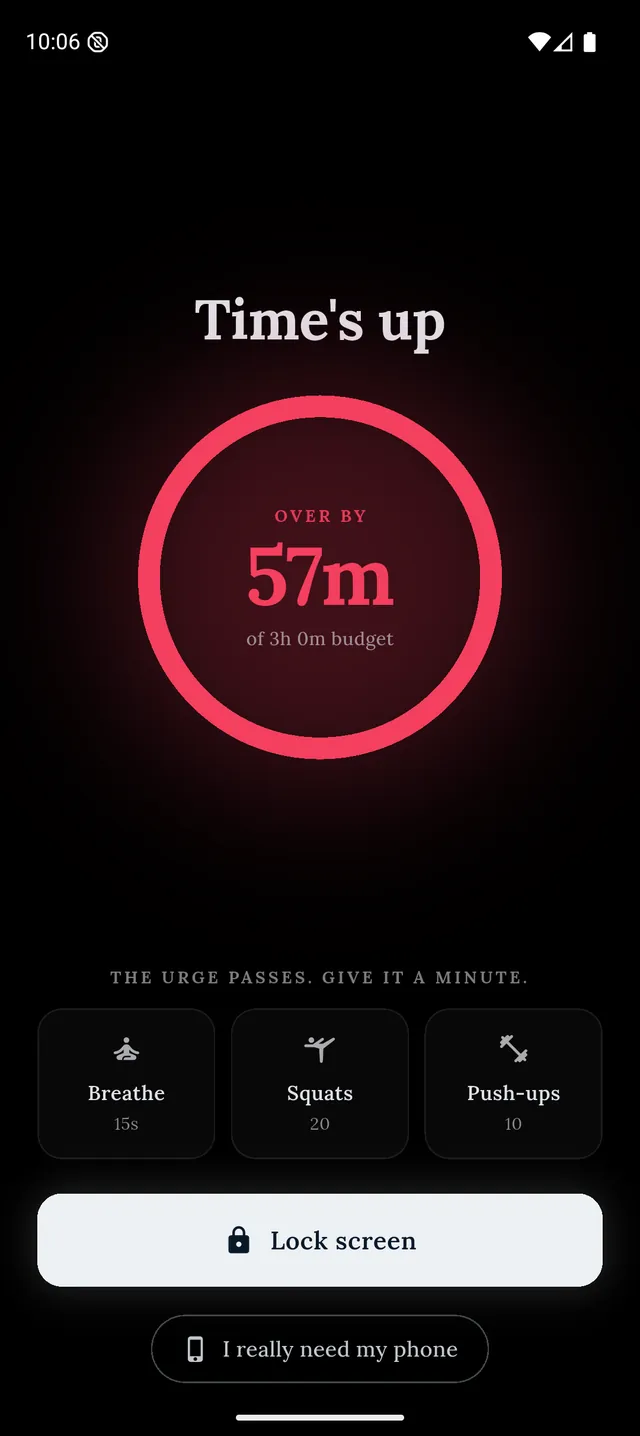
Time's up
You are out of budget for today. Take a minute, then lock the phone.
PAUSE
Then, at zero, the screen is taken over: a fifteen-second breath or twenty squats, and a button that locks the phone. If you genuinely need it, one tap extends the window and says so honestly, because an intervention you cannot escape is one you uninstall.
Disclosure: we make PhoneStop, so treat our own entry with the scepticism it deserves. Everything else here is written from public information and hands-on use; prices and platforms were checked in September 2026 and change often, so check the vendor before you pay.
PhoneStop is a free Android app. Set a daily screen time budget, get warned before it runs out, and get stopped when it does.

Android. No account, no ads. Your screen time never leaves your phone. An iPhone version is coming soon.
Questions people ask
Does minimalist phone block apps?
Not really. It hides them behind a plain text list and can put a delay in front of the ones you choose, which is friction rather than blocking. Nothing is ever unavailable.
Is there a minimalist phone for iPhone?
Not as a launcher: iOS does not allow apps to replace the home screen. iPhone users approximate it with a stripped-back home screen, the greyscale accessibility shortcut and a Focus mode.
Can I use minimalist phone and PhoneStop together?
Yes, and they were built for different halves of the problem. The launcher reduces how often you pick the phone up; the budget shortens what happens after you do. Neither interferes with the other.