Opal vs ScreenZen
One costs about $100 a year and one costs nothing. The interesting part is how much of the gap you would actually notice.
By Ruslan Shchuchkin, who built PhoneStop · · Read this page as Markdown
The short version
Try ScreenZen first, and do it before you pay anybody. It is free with no paid tier, it is on both platforms, and its pause screen plus open-count limits cover the everyday half of what most people install Opal to do. If it works, you have saved a hundred dollars a year.
Buy Opal if ScreenZen turns out to be too easy to wave away. That is the real difference: Opal's Deep Focus is a block you cannot argue with, and ScreenZen is friction you can always push through. For some people friction is plenty. For others it is a speed bump they stop noticing in a fortnight.
Do it in that order. Paying first and discovering you only needed a pause screen is the expensive mistake here.
| Opal | ScreenZen | |
|---|---|---|
| Platforms | iPhone and iPad (an Android build exists but trails the iOS app) | iPhone, iPad, Android |
| Price | Free tier, subscription for the real features (around $100/year) | Free, donation-supported |
| What it does when you hit the limit | Blocks the apps in your session; Deep Focus makes the block hard to lift | Shows a pause screen and can refuse the open once you pass your cap |
| Warns you before the limit | Session reminders, not a whole-day countdown | Per-app, at the moment you open the app |
| How it enforces | Apple's Screen Time API | Apple's Screen Time API; an accessibility service on Android |
| Blocks individual apps | Yes: per app, per website, per category | Yes: a delay, an intention prompt and an open limit per app |
| Account needed | Yes | No |
| Data leaves the device | Yes: account and cloud sync | No |
| Google Play rating | 4.5 stars (8.77K) | 4.7 stars (32.2K) |
How each one stops you
ScreenZen puts a moment between you and the app. Open Instagram and you get a pause screen, a breath, a reminder of what you said you wanted, and (if you set one) a cap on how many times you may open it today. Nothing is ever truly unavailable. The bet is that most opens are reflex, and a reflex interrupted usually does not resume.
Opal removes the app. You start a session or a schedule starts one, the app stops opening, and Deep Focus takes away the ability to end the session early. The bet is that you cannot be trusted in the moment, so the decision should be made by an earlier version of you.
Friction against removal. Which one you need is a question about how you actually fail, not about which is the better app.
Where Opal wins
- Deep Focus genuinely holds when you are trying to defeat it.
- The more finished product: onboarding, charts, presets and schedules.
- Session and schedule logic that is deeper than anything ScreenZen offers.
- Per-category blocking, so newly installed apps do not slip through.
- Support and a company behind it, which a donation-funded free app cannot promise.
Where ScreenZen wins
- It is free. No tier, no upsell, no trial that converts.
- Both platforms, properly: unlike Opal, whose Android build trails.
- The pause screen is the single most cost-effective intervention here.
- Open-count limits catch the reflex that a time limit never sees.
- No account required, and nothing to cancel later.
Both of them are still counting apps, not hours
Opal removes apps, ScreenZen slows them down, and they disagree about how hard the intervention should be. But look at the unit they both work in: the app. You name it, and something happens when you open it.
Which means neither one can answer the question you probably actually have: how much of today have I already spent? You can honour every ScreenZen pause and every Opal session and still finish a day at five hours, spread thinly across a dozen apps that individually never looked like a problem. Nothing was violated. Nothing gets flagged. The total is simply not a thing either product measures against.
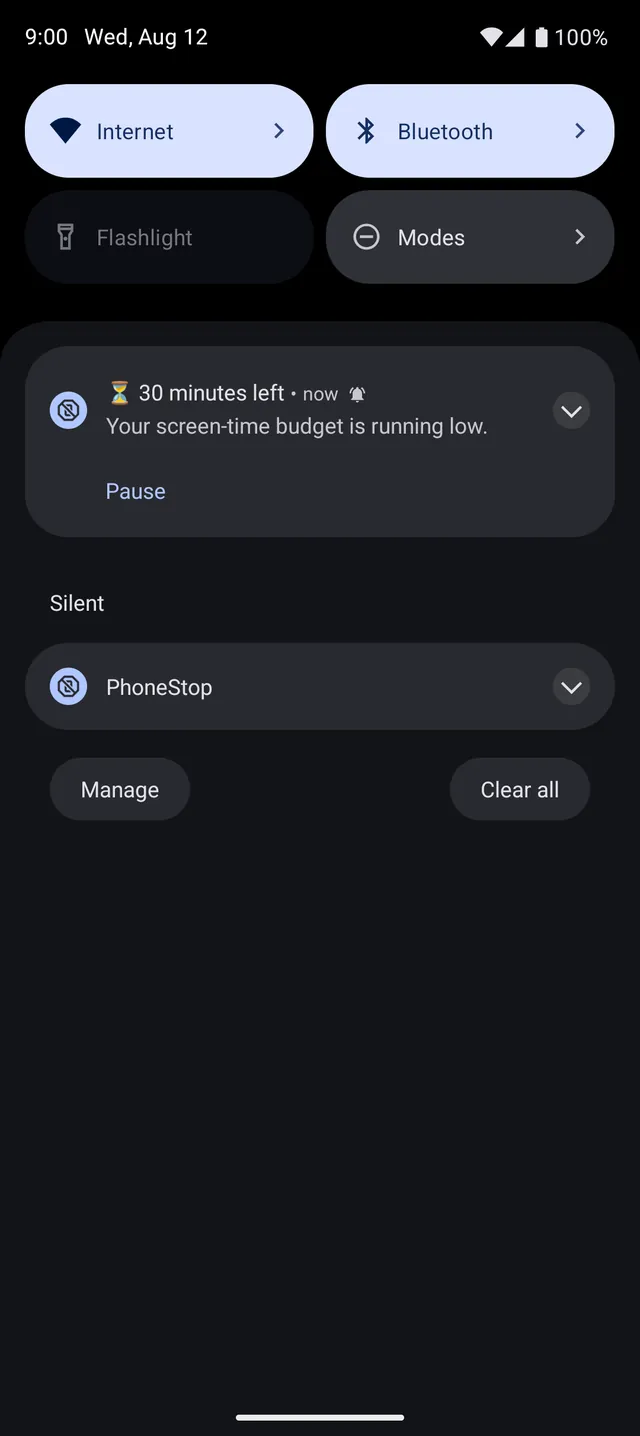
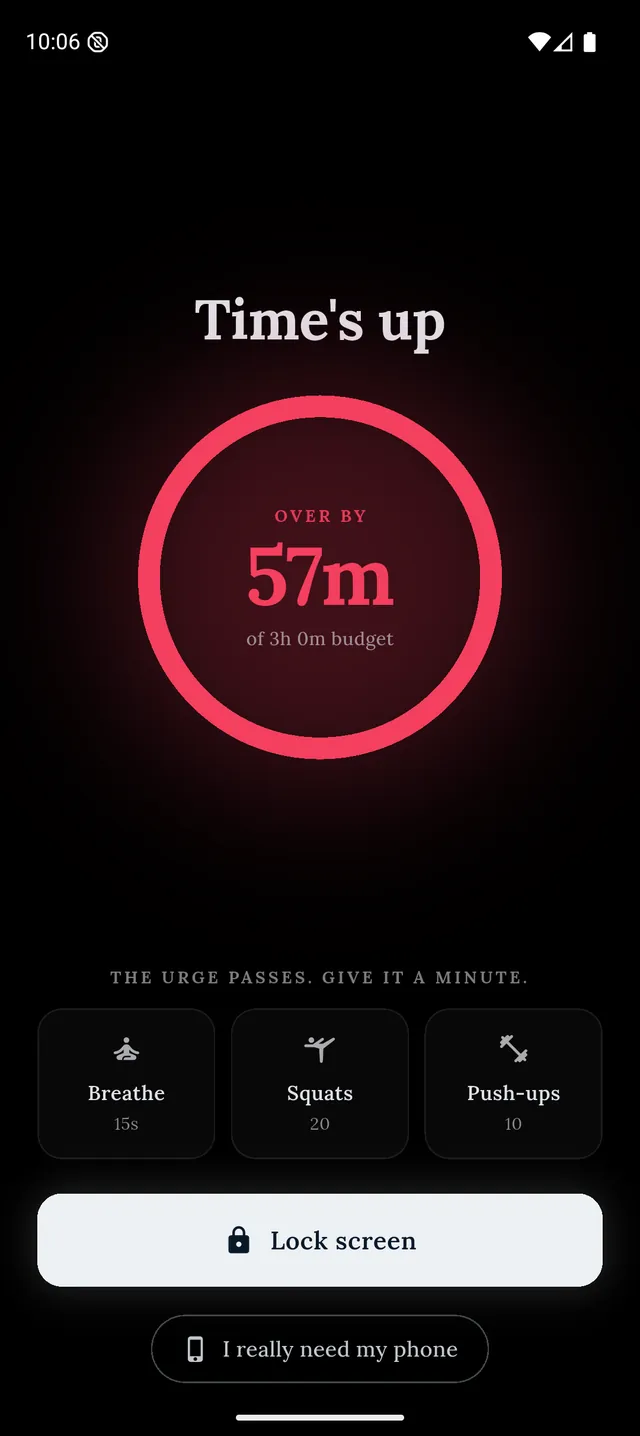
PhoneStop starts from the total and works backwards. You set what the day is worth (most people land between two and four hours) and every app spends from that one number. The ring on the home screen drains as you use the phone, warnings arrive at roughly sixty, thirty and ten minutes left inside whatever app you are in, and at zero the screen is taken over: fifteen seconds of breathing or twenty squats, then a one-tap lock.
It is free, like ScreenZen, and it needs no account. Your screen time never leaves your phone: the app sends only anonymous taps, and you can turn them off. It is Android only for now.
Disclosure: we make PhoneStop, so treat our own entry with the scepticism it deserves. Everything else here is written from public information and hands-on use; prices and platforms were checked in September 2026 and change often, so check the vendor before you pay.
PhoneStop is a free Android app. Set a daily screen time budget, get warned before it runs out, and get stopped when it does.

Android. No account, no ads. Your screen time never leaves your phone. An iPhone version is coming soon.
Questions people ask
Is ScreenZen as good as Opal?
For the everyday case, closer than the price gap suggests. Opal wins clearly on enforcement strength and polish. ScreenZen wins on being free and on covering both platforms properly.
Is ScreenZen really free?
Yes: no paid tier and no trial. It is supported by donations, which is unusual in this category and worth supporting if the app works for you.
Is Opal worth $100 a year?
Only if you have established that softer tools do not hold you. Deep Focus is the thing you are paying for. Try a free option for a fortnight first and you will know.
Which is better on Android, Opal or ScreenZen?
ScreenZen, comfortably. Opal's Android build has never matched its iOS app, while ScreenZen is built for both. See PhoneStop vs ScreenZen for the budget-based alternative.