Opal vs Jomo
The two best iPhone screen time apps, built on the same Apple API, aimed at opposite kinds of person.
By Ruslan Shchuchkin, who built PhoneStop · · Read this page as Markdown
The short version
Choose Opal if you want it to work without thinking about it. Presets, schedules, a clear score, and Deep Focus when you need the block to hold. It asks very little of you and gives back a great deal.
Choose Jomo if you enjoy configuring things. It is the deeper product by a wide margin (sessions, limits, categories, conditions) and it shows your own stated intention back to you at the moment of the block, which is the single smartest piece of design in this category.
There is also a pricing argument. Jomo offers a one-time lifetime purchase; Opal is a subscription that lands near $100 a year on its full plan. If recurring charges are the objection rather than the price, that decides it on its own.
| Opal | Jomo | |
|---|---|---|
| Platforms | iPhone and iPad (an Android build exists but trails the iOS app) | iPhone and iPad |
| Price | Free tier, subscription for the real features (around $100/year) | Subscription, with a one-time lifetime option |
| What it does when you hit the limit | Blocks the apps in your session; Deep Focus makes the block hard to lift | Blocks the app or category and shows your own intention back to you |
| Warns you before the limit | Session reminders, not a whole-day countdown | Session and limit notices |
| How it enforces | Apple's Screen Time API | Apple's Screen Time API |
| Blocks individual apps | Yes: per app, per website, per category | Yes: apps, websites and whole categories |
| Account needed | Yes | Yes |
| Data leaves the device | Yes: account and cloud sync | Apple's API keeps app content private; the account holds your settings |
| Google Play rating | 4.5 stars (8.77K) | Not on Google Play |
How each one stops you
Both sit on Apple's Screen Time API, so neither can see what you do inside an app and both block with the same underlying mechanism. What you are actually choosing between is two philosophies of interface.
Opal reduces. There is a session, there is a schedule, there is a score, and Deep Focus is the one lever that makes the block serious. Fewer decisions, better defaults, and a product that a new user has running correctly in five minutes.
Jomo expands. Categories rather than lists, so a newly installed app does not slip through a gap. Conditions, multiple limit types, and a block screen that quotes your own intention at you instead of just refusing. It is the more powerful tool and it will take you an evening to set up properly.
The trade is real: defaults that work against control that fits.
Where Opal wins
- Far faster to set up, and screen time apps are abandoned during setup more than at any other moment.
- Deep Focus is the harder block of the two in practice.
- The most polished product here: charts, onboarding, session presets.
- Focus scores and streaks genuinely motivate some people.
- Better known, so there is more written about making it work.
Where Jomo wins
- Category blocking, so a new app cannot slip past a list you wrote last month.
- A one-time lifetime purchase as an alternative to subscribing forever.
- The intention screen at the moment of the block, which is a better idea than a refusal.
- Deeper conditions and limit types than anything else on iPhone.
- No gem economy or reward theatre, if that is a thing you would rather avoid.
The setup you do today is the setup you are stuck with
Here is the thing both of these share, and it is the reason people cycle through them: they need you to be right in advance. Which apps, which categories, which hours, which conditions. Opal asks you fewer questions than Jomo, but it still asks.
Being right in advance is hard, because the answer changes. The app that ate your February is not the app that eats your June. You configure carefully, the configuration ages, and six weeks later the time has quietly relocated to something you never listed, and neither app will mention it, because as far as they are concerned every rule you wrote is being honoured perfectly.
A budget does not need to be right in advance, because it does not need to know anything about apps. One number for the whole phone, every app spending from the same pool, no categories and no conditions. Whatever the habit relocates to, it still costs you minutes, and the total is the one measurement that cannot be gamed by moving.
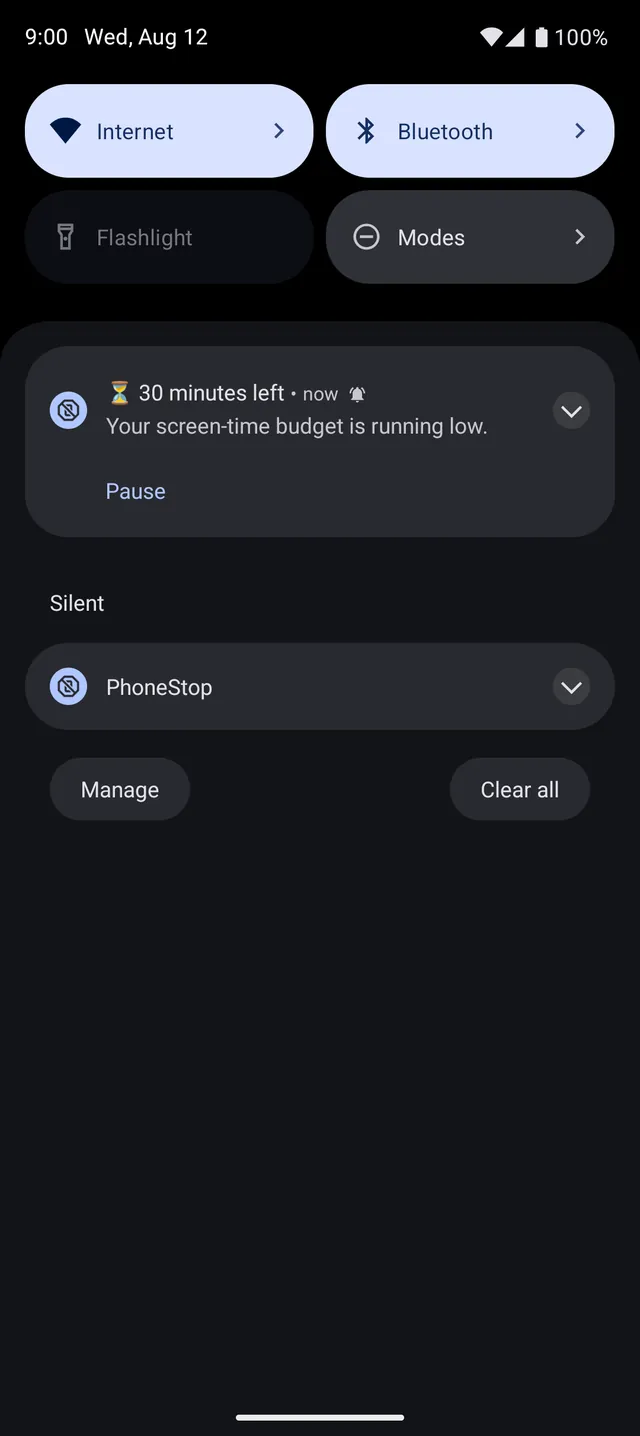
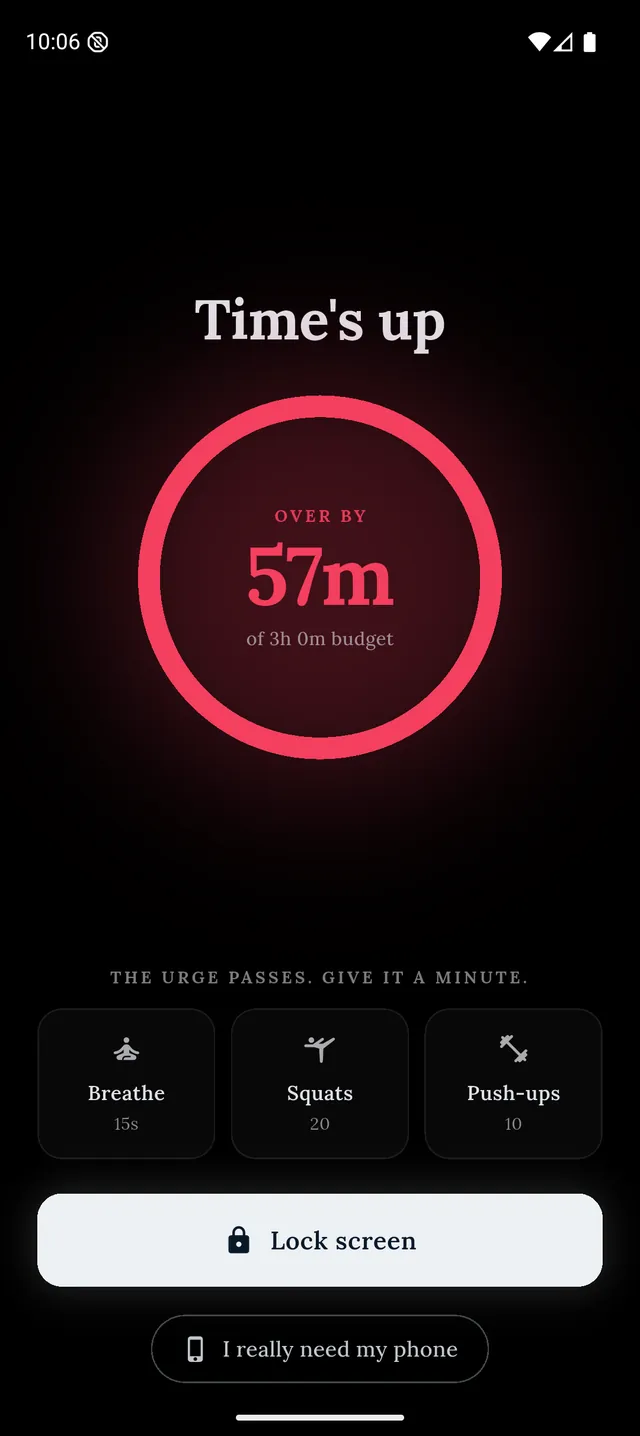
That is PhoneStop: a daily budget that counts down, warnings at roughly sixty, thirty and ten minutes left that arrive inside whatever app you are in, and a full-screen stop at zero with a breathing timer and a one-tap lock. Free, no account, no configuration beyond a single number. It is Android today, with an iPhone version in progress, so if you are choosing this week, this is a comparison to file rather than act on.
Disclosure: we make PhoneStop, so treat our own entry with the scepticism it deserves. Everything else here is written from public information and hands-on use; prices and platforms were checked in September 2026 and change often, so check the vendor before you pay.
PhoneStop is a free Android app. Set a daily screen time budget, get warned before it runs out, and get stopped when it does.

Android. No account, no ads. Your screen time never leaves your phone. An iPhone version is coming soon.
Questions people ask
Is Jomo better than Opal?
Jomo is more capable and Opal is easier to live with. If you will genuinely configure it, Jomo gives you more; if you want it running properly tonight, Opal does that better.
Is Jomo cheaper than Opal?
Jomo offers a one-time lifetime purchase, which Opal does not, so over a few years it is usually the cheaper of the two. Compare the current plans before paying: both move.
Do Opal and Jomo use the same technology?
Yes. Both are built on Apple's Screen Time API, which is why neither can see inside your apps and why neither has a real Android equivalent.
What is the Android version of Opal or Jomo?
There is no exact match, because Android has no Screen Time API. AppBlock is closest for blocking, StayFree for tracking, and PhoneStop for a daily budget with a hard stop.