AppBlock vs Opal
These are the same idea on opposite platforms: a strong, schedulable blocker. Which one you should read about depends entirely on the phone in your hand.
By Ruslan Shchuchkin, who built PhoneStop · · Read this page as Markdown
The short version
Choose AppBlock if you are on Android. Profiles, schedules, per-app and per-website blocking, and a Strict Mode that refuses to be switched off, with a usable free tier.
Choose Opal if you are on iPhone. It is the more polished product, built on Apple's Screen Time API, with Deep Focus for a hard block. It leans on a subscription near $100 a year.
This one is mostly decided for you by your platform. Match the app to the phone.
| AppBlock | Opal | |
|---|---|---|
| Platforms | Android, iPhone | iPhone and iPad (an Android build exists but trails the iOS app) |
| Price | Usable free tier; premium by month, year or a one-time payment | Free tier, subscription for the real features (around $100/year) |
| What it does when you hit the limit | Blocks the profile's apps and sites, and Strict Mode refuses to be turned off | Blocks the apps in your session; Deep Focus makes the block hard to lift |
| Warns you before the limit | Profile start and end notices | Session reminders, not a whole-day countdown |
| How it enforces | Usage access, plus an accessibility service for websites and Strict Mode | Apple's Screen Time API |
| Blocks individual apps | Yes — profiles, schedules, per app and per website | Yes — per app, per website, per category |
| Account needed | Optional | Yes |
| Data leaves the device | Optional account | Yes — account and cloud sync |
| Google Play rating | 4.7 stars (240K) | 4.5 stars (8.77K) |
How each one stops you
AppBlock runs on usage access plus an accessibility service for website blocking and Strict Mode, and it is at its strongest on Android. Opal runs on Apple's Screen Time API and is at its strongest on iPhone; its Android build trails.
So the enforcement is comparable in spirit, both build profiles and block what you list, but each is tuned to a different operating system, and each is weaker on the other.
Where AppBlock wins
- Built for Android, where it is one of the strongest blockers.
- Strict Mode that will not let you turn it off.
- A usable free tier, with a one-time payment option.
- Profiles and schedules in real depth.
Where Opal wins
- The more polished product, on iPhone.
- Deep Focus for a hard, considered block.
- Categories and routines done cleanly.
- The default recommendation for iOS.
The review you read is not always the app you get
The catch with AppBlock-versus-Opal is that they barely overlap: AppBlock is an Android app and Opal is an iPhone app, so the glowing review you found may be for the platform you are not on. What they do share is the blocklist model, you name the apps, you build the profiles, and the day's distraction quietly moves to whatever profile you forgot to include.
PhoneStop skips the profiles. It budgets the whole phone with one daily total, so there is nothing to configure per app and nothing for the habit to slip past. It is free on Android today, with an iPhone version coming, and it treats every app as the same time coming out of the same total.
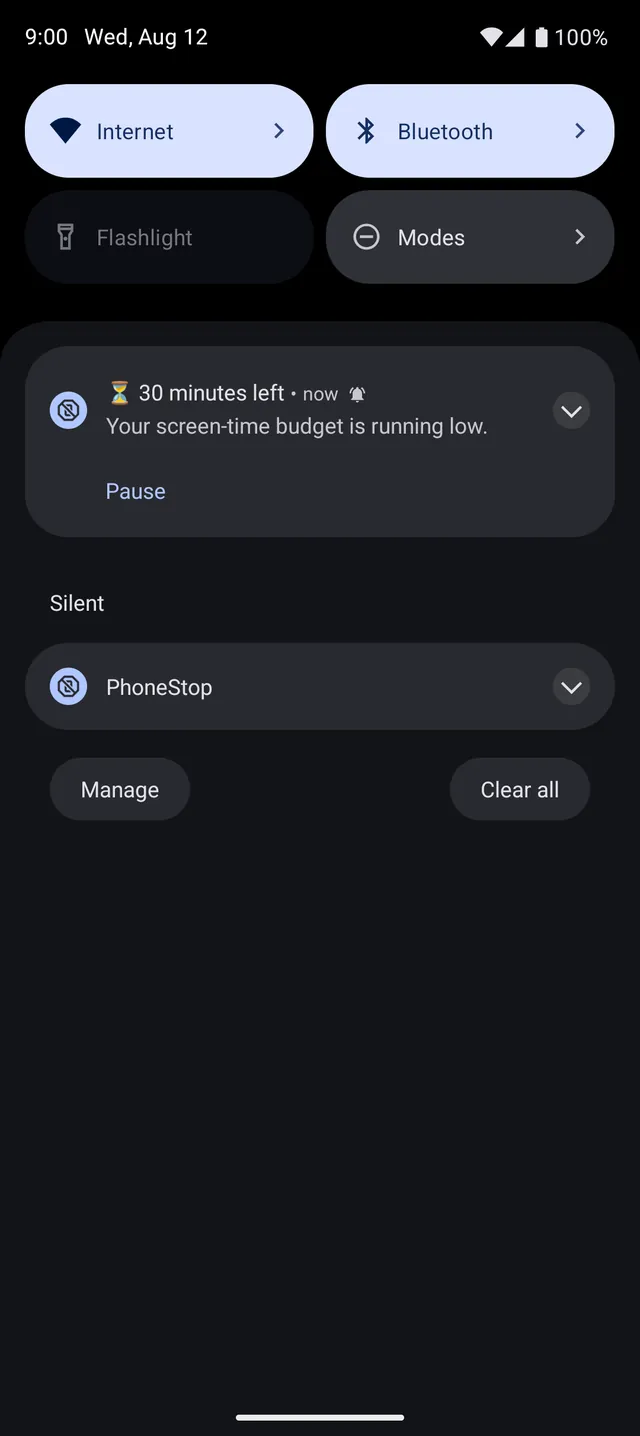
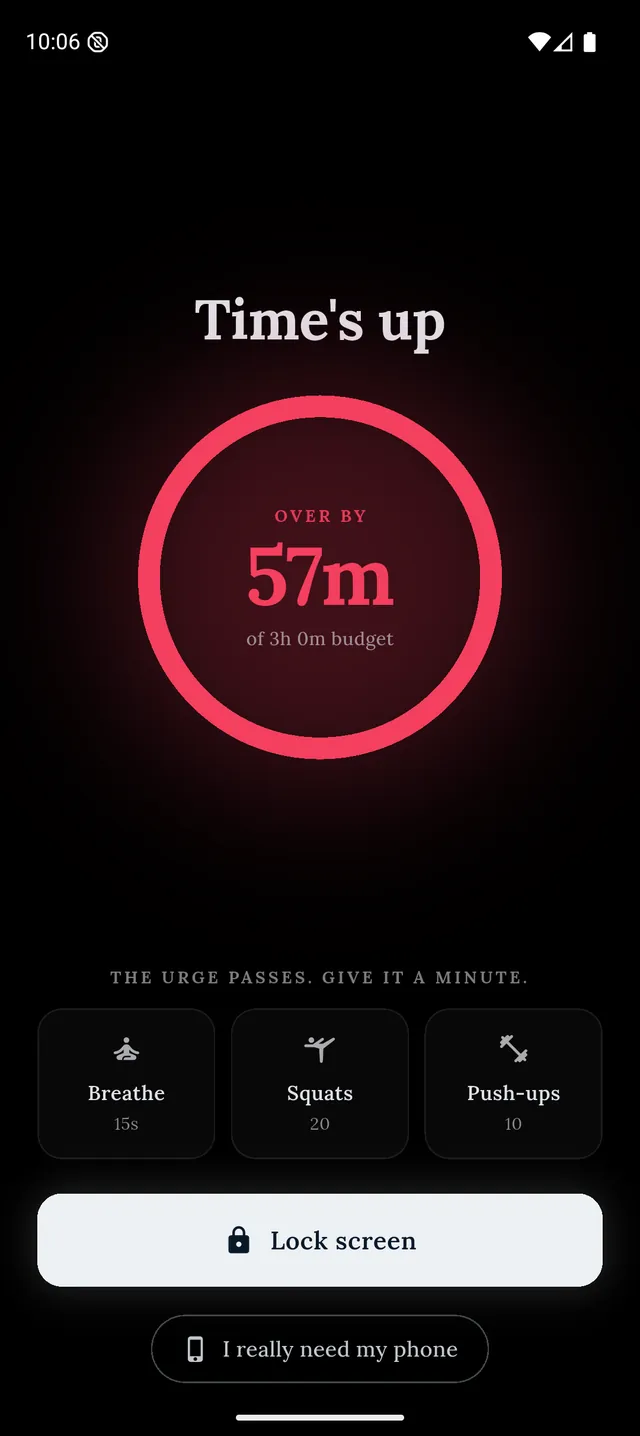
Disclosure: we make PhoneStop, so treat our own entry with the scepticism it deserves. Everything else here is written from public information and hands-on use; prices and platforms were checked in September 2026 and change often, so check the vendor before you pay.
PhoneStop is a free Android app. Set a daily screen time budget, get warned before it runs out, and get stopped when it does.

Android. No account, no ads, no data leaves your phone. An iPhone version is coming soon.
Questions people ask
AppBlock or Opal, which is better?
Whichever matches your phone. AppBlock is the stronger Android blocker; Opal is the more polished iPhone one. They are not really competing on the same device.
Is AppBlock free?
It has a usable free tier, with premium by month, year or a one-time payment. Opal's real features are a subscription.
Does either limit my whole phone?
Both block by profile and app, not by a whole-phone daily total. That total is what PhoneStop budgets instead.